Cippico Palace


0
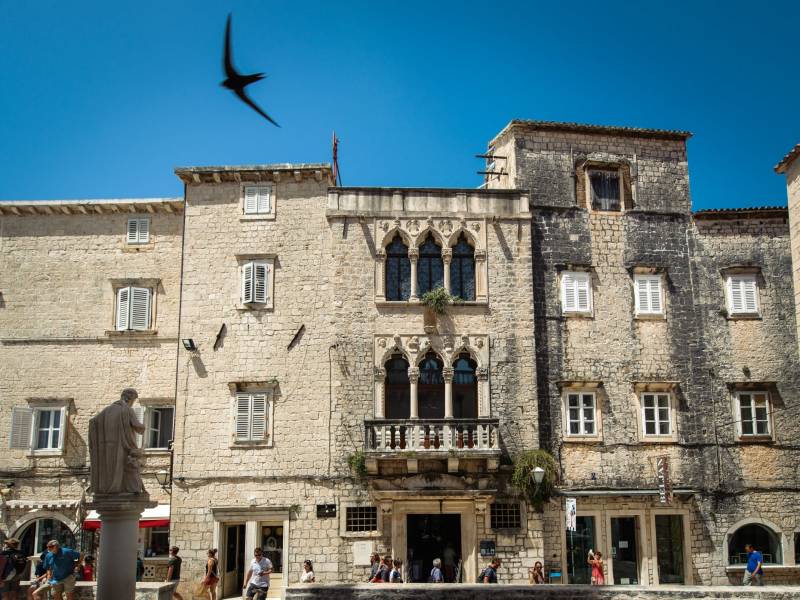
You are in front of the Cippico Palace, located opposite the Cathedral of St. Lawrence, and it did not face the square by chance. It was built to be seen – and for everyone to know who had power in this city. The family to which it belonged was not just wealthy. In the 15th century, the Cippicos played a key role in the political and cultural life of Trogir. They were local, but they did not stay local. Their most famous descendant, Coriolanus Cippico, best demonstrates this. He grew up within these walls, but he did not stay behind them. He became a military commander and humanist in the service of the Venetian Republic. He fought at sea, recorded what he experienced, and turned it into De bello Asiatico – a work that today is valid as a historical document and literary text in one. While he was writing about the battles, the palace was undergoing its greatest transformations. The family systematically bought the surrounding houses and connected them into a single whole. What you see today is the result of that expansion, and the eye-catching facade was shaped by Andrija Aleši – a sculptor who knew how stone could serve prestige. The triforia and the balcony on the east side were not placed for beauty. Every cut, every decoration was a message. They belonged to the world of Renaissance ideas, but they did not forget to show that they also belonged to the top of society. The inner courtyard hides an object you would not expect – a metal figure of a rooster. It was taken from an Ottoman galley captured at Lepanto. It is not a decoration, it is a war trophy and a warning. This family did not just participate in history because at one point, they dictated it. The palace is not open today. You cannot enter, but you can see enough - a place where ambition, politics, art and power lived under the same roof.