0
A walking tour from ExCeL and the Royal Docks, across the Thames by cable car, to Greenwich. 15 stops, about 7 km on foot, around two and a half hours at a normal pace. The walk covers the old docks, the Greenwich Peninsula, the Old Royal Naval College, the Cutty Sark and the Royal Observatory. The cable car needs its own ticket. If it is not running, take the DLR from Royal Victoria to Canning Town and the Jubilee line to North Greenwich. There is no fixed order: you can join anywhere, skip stops and turn back, and each point plays when you enter its geofence.

Welcome to GuideToGo in London. This tour takes you from ExCeL, across the Thames by cable car and all the way up to the Prime Meridian in Greenwich. If you only have a few minutes between meetings, start with the next three points, all just outside ExCeL. It takes about ten minutes and gives you a taste of how the guide works: walk towards a point, and the story starts on its own when you get there. If you have more time, carry on with the full 15-point tour. You ride the cable car across the river, pass the O2, follow the Thames to Greenwich and finish at the Royal Observatory. Allow around two and a half hours.

The long building beside you is ExCeL, and it stands on the quay of a dock that once took in cargo from all over the world. When the Royal Docks closed to shipping in 1981, this waterfront was left to empty warehouses and weeds. ExCeL opened here in November 2000. Every November the travel industry comes here. World Travel Market moved to ExCeL in 2002, and today around five thousand exhibitors from more than 180 countries fill the halls for three days of meetings and deals. In the summer of 2012 the same halls held Olympic boxing, judo, fencing, table tennis and weightlifting. But the strangest chapter came in the spring of 2020. On 24 March, with COVID spreading fast, it was announced that ExCeL would become a hospital. Ten days later NHS Nightingale opened, planned for up to 4,000 beds, with 700 soldiers helping with the logistics. Then something happened that nobody had dared to count on. London's ordinary hospitals coped. Over the whole first wave, the biggest of Britain's emergency hospitals treated just 54 patients. It may be the only hospital in history that was a success because it stayed almost empty.

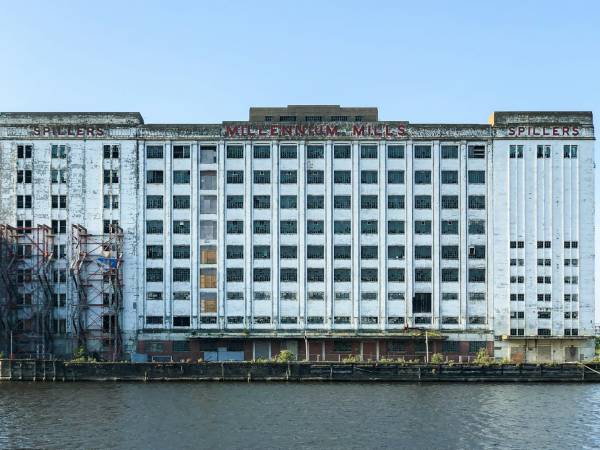
This long stretch of water was dug out of marshland and opened in 1855. It was the first dock in London built for the big new steamships, the first to be linked to the national railway network, and the first to run its machinery on hydraulic power. Within five years it was handling twice as much cargo as the older London Docks upriver. The engineer behind it was George Parker Bidder, and his story begins at country fairs in Devon. Bidder was a stonemason's son with a gift nobody could explain. Before he had any real schooling, his father was touring him round the country as the Calculating Boy. He was asked how many times a coach wheel five feet ten inches round would turn on a journey of 800 million miles. In under a minute he answered: 724,114,285,704. The boy who did sums for coins at fairs grew up to be one of the great engineers of the railway age, and designed this dock. The cranes along the quay were kept as monuments when the docks closed in 1981. They have seen worse days than this. On 7 September 1940, the first day of the Blitz, German bombers came for London's docks, and the warehouses along this water burned through the night.

The glass building shaped like a cut crystal is London's City Hall, though it was never built to be one. Siemens put it up in 2012 as a showcase for green technology. In January 2022 the Mayor of London and the London Assembly moved in, leaving the rounded glass City Hall beside Tower Bridge to save money. The city's government now sits in the old docks, some ten kilometres east of Westminster, and that says something about which way London is growing. Next door is the cable car across the Thames. It opened in June 2012, just before the Olympics, and climbs to 90 metres above the river. It was sold as a new link for commuters. In October 2013 it emerged that only four people were using it regularly to get to work. Today it carries around one and a half million passengers a year, nearly all of them there for the view. A practical note before you go up. The cable car has its own fare, which you pay by tapping a contactless card or Oyster at the gate, or with a ticket from the machines. It closes in the evening and stops in strong wind. If it is not running, take the DLR one stop from Royal Victoria station, just beside you, to Canning Town, and then the Jubilee line one stop to North Greenwich, next to the O2. It takes about fifteen minutes, and the tour picks up again from there.

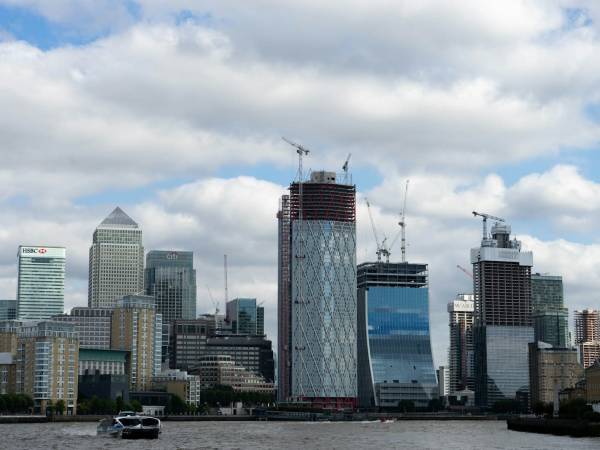
You are now crossing the Thames at up to 90 metres above the water. From up here you can read the whole story of London's river in one sweep. Look west, up the river, to the cluster of towers. That is Canary Wharf, built on the old West India Docks. The name comes from a quay built in the 1930s for fruit shipped in from the Canary Islands. Where crates of bananas and tomatoes were once unloaded, some of the world's biggest banks now have their offices. In the early 1900s this was one of the busiest stretches of river on Earth, crowded with ships waiting for a berth. Then came the shipping container. The new ships were too big for the old docks, and one by one the docks closed, the Royal Docks last of all, in 1981. Thousands of dockers lost their work within a few years, and whole neighbourhoods lost their reason for being. Now look east, down the river. On a clear day you can pick out a row of shining steel hoods across the water. That is the Thames Barrier, completed in 1982. Its gates can be raised to hold back a surge tide from the North Sea, and it has been closed more than two hundred times to keep London dry.

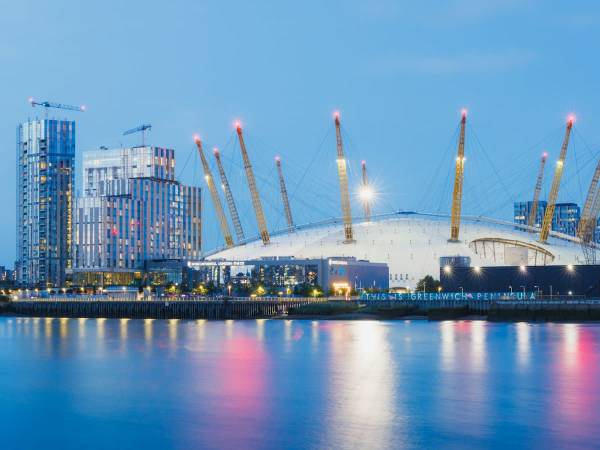
Count the yellow masts poking up through the roof. There are twelve, one for each month of the year, or each hour on a clock face. The dome is 365 metres across, one for every day of the year, and 52 metres high at the centre, one for every week. It was built to celebrate the year 2000, and every measurement was meant to say so. It opened on New Year's Eve 1999 as the Millennium Dome, with an exhibition that was supposed to draw twelve million visitors in a year. Just over six million came. It closed after twelve months and became a national joke, a £789 million project nobody knew what to do with. Its most famous visitors that year never bought a ticket. On 7 November 2000 a gang drove a JCB digger through the fence, set off smoke bombs and attacked the glass case holding the Millennium Star, a flawless 203-carat diamond. A speedboat was waiting on the river for the getaway. What they did not know was that the police had been tracking them, had swapped the diamonds for replicas, and were hiding behind a false wall a few metres away. In 2007 the dome reopened as The O2, and it has since become one of the busiest concert venues in the world.

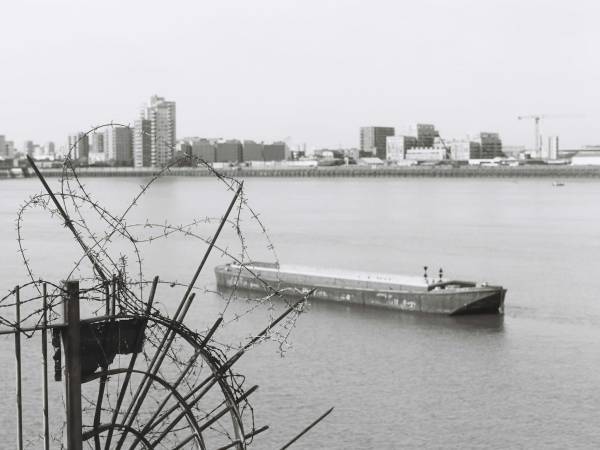
You are near the northern tip of the Greenwich Peninsula, a corner of the river that sailors knew as Blackwall Point. For ships coming up from the sea, this was where London began to feel close. It was also where they got a warning. Pirates caught on the Thames were hanged at Execution Dock in Wapping, a few kilometres upriver. The bodies of the worst of them were then brought down here, locked into iron cages and hung high at the water's edge, left to rot in full view of every passing crew. Nobody on deck needed the message explained. Now look across the water to the far bank, where the River Lea joins the Thames. You may spot a small lighthouse. It is London's only lighthouse, and it was never meant to guide a single ship. Trinity House, which runs the lighthouses of England and Wales, built it in 1864 for testing lamps and lenses, and the great scientist Michael Faraday worked on lighthouse lighting at the wharf over there. Today the lighthouse is home to Longplayer, a piece of music composed to play for a thousand years without repeating itself. It began at midnight as 1999 turned into 2000, and it is due to end on the last day of 2999.

Somewhere along this stretch of path you cross the Greenwich Meridian, the line of zero longitude. Step one way and you are in the eastern hemisphere. Step the other way and you are in the western. The line carries on across the river and north through east London. The rusty slice of ship by the water sits almost exactly on it. It is an artwork by Richard Wilson called A Slice of Reality, made in 2000 from the Arco Trent, a sixty-metre sand dredger. Wilson kept a vertical section nine metres thick, about fifteen percent of the ship, and let the rest go for scrap. What remains is a cross-section of a working life at sea: the bridge, the cabins, the crew's quarters, even a pool table, all open to the wind. The ground under your feet has a story of its own. For almost a century this peninsula was covered by the East Greenwich Gas Works, which at its height spread over 240 acres and was the largest gasworks in Europe. It turned coal into the gas that lit and heated London, and left the soil so poisoned that it had to be cleaned up before anything else could be built here. The dome, the flats and the parks around you all stand on that cleaned-up ground.

The small house with the corner bay window is Enderby House, and it links two very different ways of reaching across the world. The first was whaling. Samuel Enderby & Sons was one of Britain's great whaling firms, with sixty-eight ships at sea by 1791. An Enderby ship was the first to hunt whales in the Southern Ocean, and an Enderby expedition gave its name to Enderby Land in Antarctica. The firm was famous enough for Herman Melville to write it into Moby-Dick. In chapter one hundred, Captain Ahab meets a London whaler called the Samuel Enderby, whose captain has lost an arm to the white whale. The second was the telegraph. From 1857 this wharf made cable to be laid on the seabed, and in 1858 the first cable across the Atlantic, partly made here, went into service. It lasted three weeks. Queen Victoria's greeting to the American President took sixteen hours to get through, and then the cable failed. In 1866 a new cable from this wharf was laid by Brunel's giant ship, the Great Eastern, and this time it held. News that had taken ten days by ship now crossed the ocean in minutes. The factory is still working, making equipment for the undersea cables that carry almost all the internet traffic between continents.

A small white almshouse sits here in the shadow of a power station. The low building with the little tower and battlements is Trinity Hospital, founded in 1613 by Henry Howard, Earl of Northampton, as a home for twelve poor men of Greenwich and eight from his native Norfolk. More than four hundred years later it still does the same job, today as homes for older people of limited means, run by the Mercers' Company. Towering over it is Greenwich Power Station, opened in 1906 to power London's electric trams. Its builders picked a difficult spot, because the station stands almost exactly on the line of the Prime Meridian, right below the Royal Observatory on the hill. The astronomers objected that the chimneys would spoil their observations, and the second pair were built shorter to keep the peace. The station has never quite retired. Since 1988 it has been the emergency power supply for the London Underground. A short walk along the river is the Trafalgar Tavern, opened in 1837. Charles Dickens set the wedding breakfast in Our Mutual Friend there, and Victorian cabinet ministers came for its famous whitebait dinners. The last was in 1885, when Gladstone's outgoing government dined together.

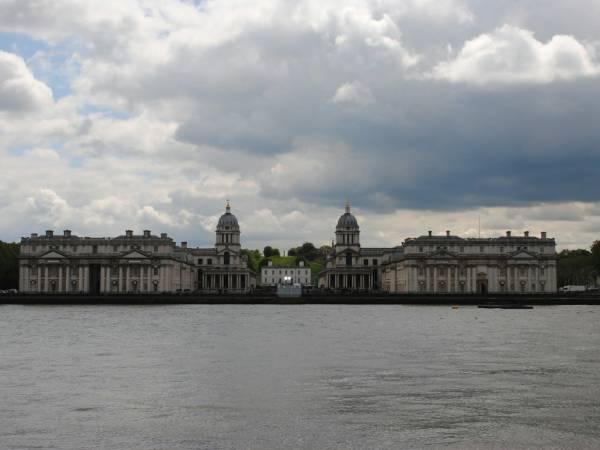
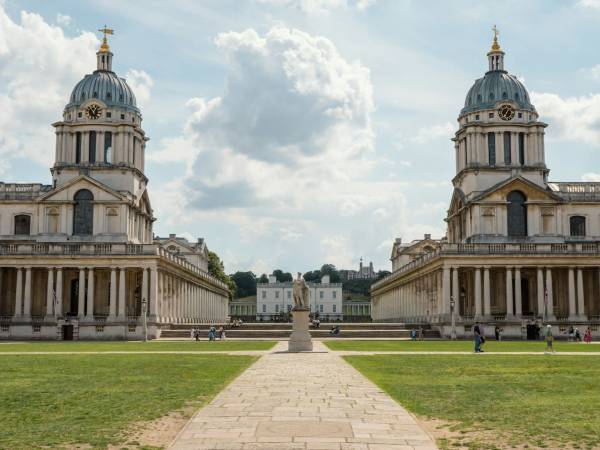
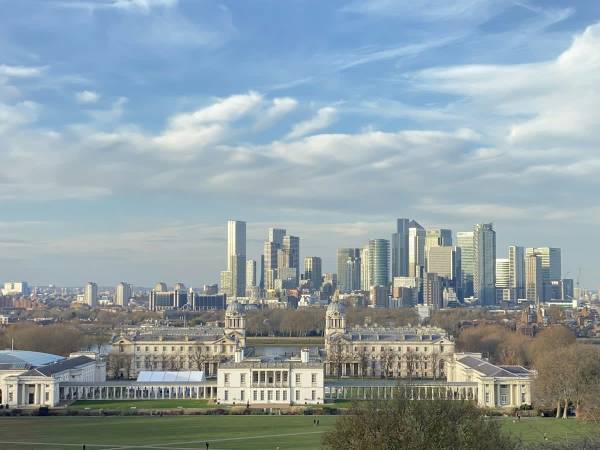
Notice how the two domes stand apart, leaving a wide gap down the middle. That gap is the whole point. When Christopher Wren designed a hospital here for old and injured sailors in the 1690s, Queen Mary II insisted that the view between the Queen's House and the river must not be blocked. So Wren split his building in two, and you can still look straight through from the water to the small white house at the foot of the park. Before the hospital, this was the site of Greenwich Palace, where Henry VIII was born, and after him his daughters Mary I and Elizabeth I. Under the western dome, the one nearest the Cutty Sark, is the Painted Hall. James Thornhill spent nineteen years painting it, from 1707 to 1726, much of the time on his back on the scaffolding with one arm raised, and his posture was never the same again. He was paid by the square yard, three pounds for the ceiling and one pound for the walls. The result was judged too grand for everyday meals, and the pensioners ate in the rooms below instead. In January 1806 Admiral Nelson's body lay in state in the hall for three days, and thirty thousand people came to pay their respects.

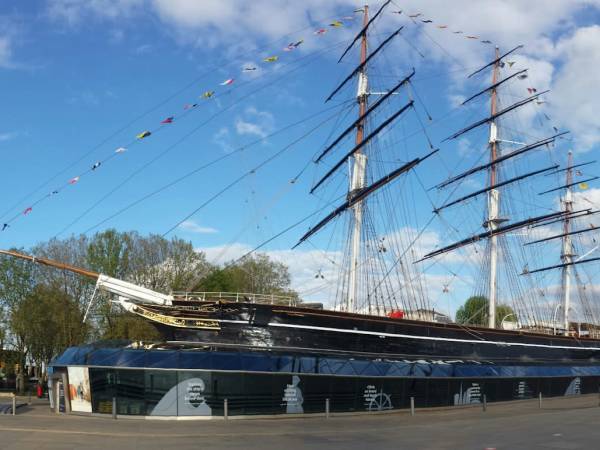
The Cutty Sark was built in 1869 to do one thing faster than anyone else: bring tea from China to London. The tea clippers raced each other home, because the first cargo of the new season fetched the best price. She could hardly have been launched at a worse moment. The Suez Canal opened that same month, giving steamships a short cut that sailing ships could not use, and within a few years the tea trade was lost to steam. So she turned to carrying wool from Australia instead, and on that run she was among the fastest ships afloat, with some voyages taking just 73 days. Her name comes from a poem by Robert Burns. In Tam o' Shanter a young witch wearing a cutty sark, Scots for a short shirt, chases Tam on his horse and pulls off its tail. Look at the figurehead. She is holding the tail in her hand. The ship has stood in dry dock here since 1954, and after a fire in 2007 she was raised three metres so that visitors can walk beneath her hull. The round, domed building close by is the entrance to the Greenwich Foot Tunnel, opened in 1902 so that workers could walk under the river to the docks and shipyards on the Isle of Dogs. It is 370 metres long, lined with some two hundred thousand white tiles, and open day and night.

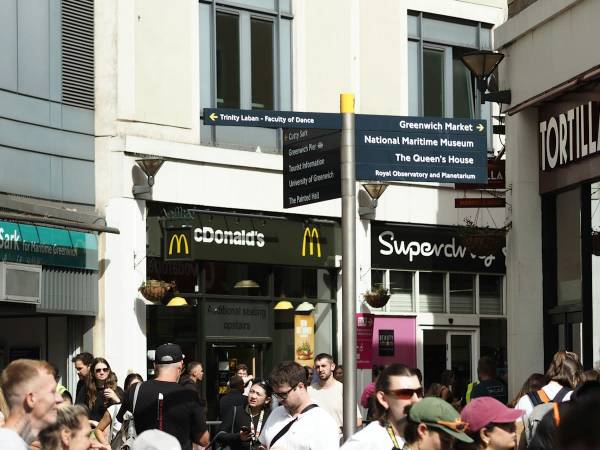
This church stands where, according to tradition, an Archbishop of Canterbury was killed by Vikings. In 1011 a Danish army captured Archbishop Alfege at Canterbury and brought him to their camp here in Greenwich, demanding a huge ransom. He refused to let anyone pay it. At a drunken feast in April 1012 his captors pelted him with bones and the heads of cattle, and one of them finished him off with the back of an axe. The church that grew up in his memory is where Henry VIII was baptised in 1491. Its roof collapsed in a storm in 1710, and the building you see now was designed by Nicholas Hawksmoor and finished in 1714. Buried here are the composer Thomas Tallis and General James Wolfe, who died winning the Battle of Quebec in 1759. Incendiary bombs destroyed the roof and much of the interior in 1941, and it took until 1953 to restore. Across the street is Greenwich Market. It was granted a royal charter in 1700, and the profits went to the naval hospital by the river. Look for the words over the entrance arch: 'A false balance is an abomination to the Lord, but a just weight is his delight.' A Bible verse, and a fairly clear message to anyone tempted to cheat on the scales. But enough about scales. What you should really do here is eat. The market is packed with stalls serving seriously good street food from all over the world, so take your time, have a wander and grab whatever smells best.

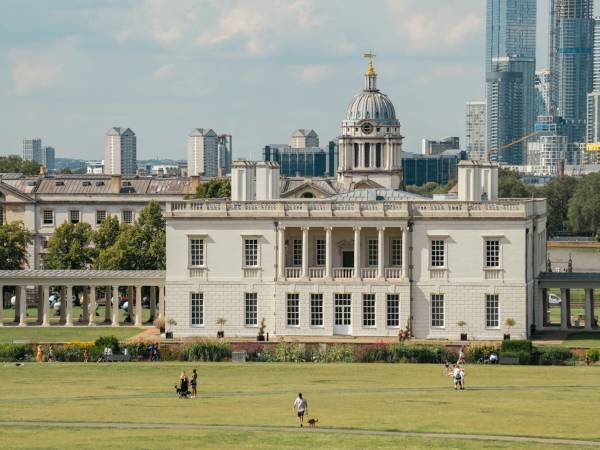
The white house at the centre is the Queen's House, and when it was finished in 1635 there was nothing else like it in England. The architect Inigo Jones had come home from Italy full of Roman and Renaissance ideas, and this was the first fully classical building in the country: pale, symmetrical and calm, at a time when English houses were red brick and crowded with gables. It was begun in 1616 for Anne of Denmark, the Danish-Norwegian princess who had married James, then King of Scotland, in Oslo in 1589. The story goes that the house was an apology. During a hunt Anne accidentally shot the king's favourite dog, and he swore at her in front of everyone. The house was built straddling the main road from London to Dover, as a private bridge between the palace by the river and the royal park. Inside is the Tulip Stairs, the first geometric self-supporting spiral staircase in Britain. In 1966 a retired Canadian clergyman photographed the stairs, which he said were empty. When the film was developed, a shrouded figure seemed to be climbing them. Nobody has explained the picture since. The wings on either side belong to the National Maritime Museum, opened in 1937. Among its two million objects is the coat Nelson was wearing when he was shot at Trafalgar, with the bullet hole still in the shoulder. Entry is free.

Greenwich Park was enclosed in 1433, which makes it the oldest enclosed royal park in London. The Tudors hunted and held jousts here, and legend says that Henry VIII and Anne Boleyn danced around a great oak up on the hilltop. Their daughter, Elizabeth I, is said to have picnicked in its shade. Queen Elizabeth's Oak died in the 1800s, and the park keepers used its hollow trunk as a lock-up for troublemakers. The ivy held it upright for about another century, until it finally fell in 1991. It still lies where it came down. On the slope up to the Observatory, something darker happened. On 15 February 1894 a young French anarchist called Martial Bourdin walked into the park carrying a homemade bomb. It went off in his hands before he reached the top, and he died of his injuries shortly afterwards. Nobody ever found out for certain what he meant to attack, though most people assumed it was the Observatory itself. Joseph Conrad turned the story into his novel The Secret Agent, in which a plot to blow up the Greenwich Observatory goes horribly wrong. It has been called the first international terrorist incident in Britain, and it happened on an ordinary February afternoon, on a path in a park.

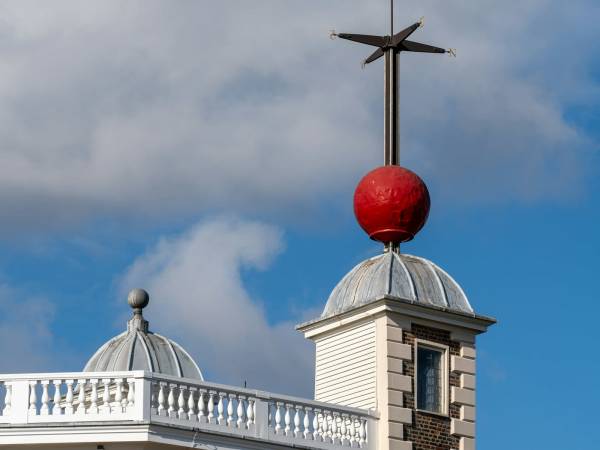
King Charles II founded the Royal Observatory in 1675 with one urgent job: to work out how ships could find their longitude at sea. Sailors could tell how far north or south they were from the sun and stars, but not how far east or west, and ships were wrecked because of it. The answer turned out to be time. If you know the exact time at home and the local time where you are, the difference tells you your position. John Harrison's sea clocks, which cracked the problem, are on display inside. In 1884 delegates from twenty-six countries met in Washington to choose one prime meridian for the whole world. They voted twenty-two to one for the line through this observatory, largely because most of the world's sea charts already used it. France abstained and kept its own Paris time until 1911. So every time zone on Earth is counted from here, including the times printed on every flight ticket you have ever held. One last thing. If you stand on the line in the courtyard and check the GPS on your phone, it will not say zero. Satellite systems put zero longitude about 102 metres further east. And look up at the red ball on the roof. Since 1833 it has dropped at exactly one o'clock every day, so that ships on the river could set their clocks.