0
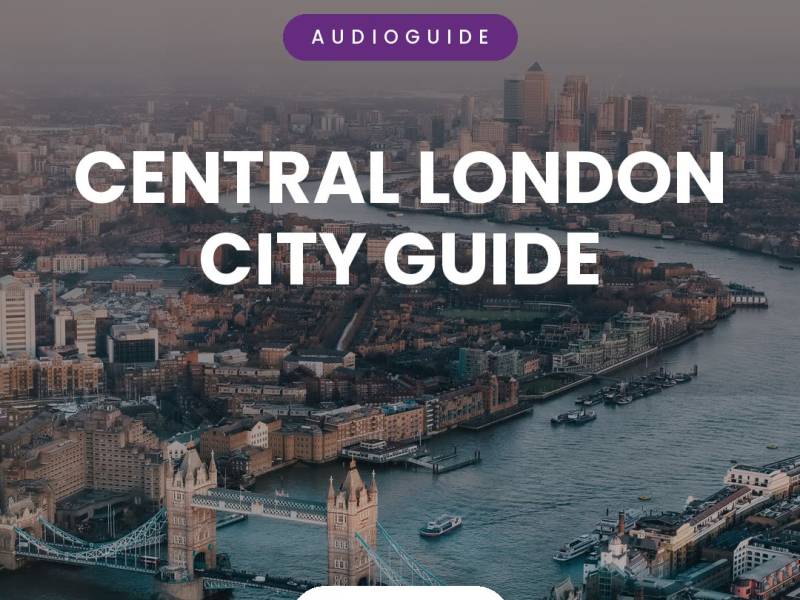
Experience some of the most iconic sights of London, one of the world's most visited cities. Take in 18 stops on a suggested route from Buckingham Palace through Westminster and along the South Bank to Tower Bridge, or discover them by wandering on your own. Enjoy discovering. About 8–9 km, roughly three hours at an easy pace. We recommend following the stops in order from 1 to 18, but you can start anywhere, and each story plays by itself when you arrive.

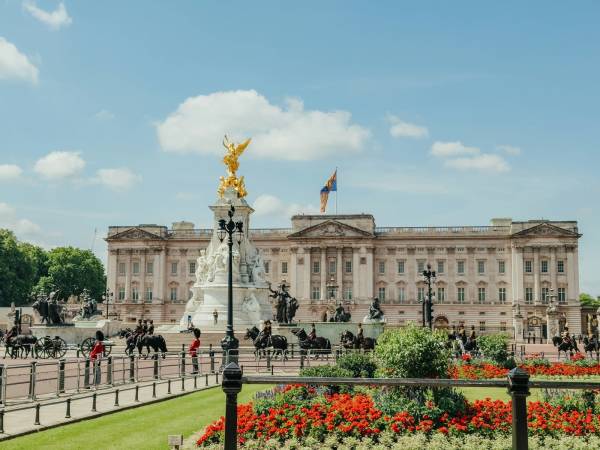
Experience some of the most iconic sights of London, one of the world's most visited cities. Take in 18 stops on a suggested route from Buckingham Palace through Westminster and along the South Bank to Tower Bridge, or discover them by wandering on your own. Enjoy discovering. We recommend following the stops in order, from 1 to 18, but every story stands on its own, so you're free to wander too. Each point plays by itself when you arrive. You're standing on the steps of the Victoria Memorial, facing Buckingham Palace. The palace started life as a townhouse. It was built in 1703 for the Duke of Buckingham, and George III bought it as a family home for Queen Charlotte. Well over a century passed between the first brick and the first monarch to actually live here. The first was Queen Victoria, in the same year she came to the throne. The grand front you're looking at is younger than it seems. Its stone facing only went up in 1913. And when the east wing was built to close off the courtyard, the old ceremonial gateway, Marble Arch, was suddenly in the way. It was taken down and rebuilt at the corner of Hyde Park, where it still stands. Now look at the flagpole on the roof. If the colourful Royal Standard is flying, the King is at home. If it's the Union Flag, he's somewhere else. Next stop: Trafalgar Square, about 1.4 kilometres or 20 minutes straight down The Mall and through Admiralty Arch.

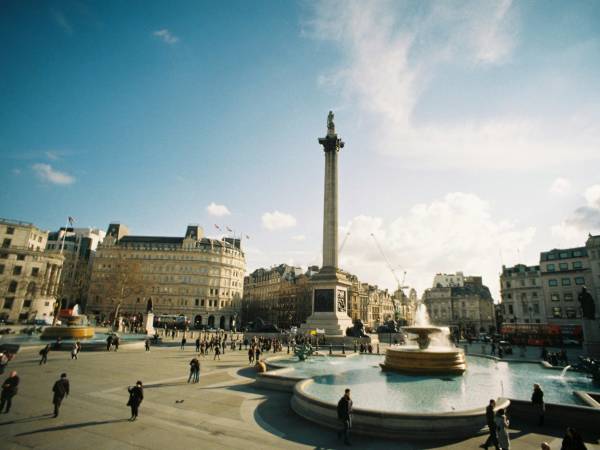
You're standing on the terrace in front of the National Gallery, with all of Trafalgar Square spread out below you. It's named after Admiral Nelson's victory over the French and Spanish fleets at Trafalgar in 1805. He won the battle, but was killed during it. His column in the middle stands about fifty metres tall. The bronze panels around its base were cast from captured enemy cannon, and on the south side you can watch Nelson die. During the Second World War, Hitler reportedly planned to ship the whole column to Berlin if his invasion of Britain succeeded. Look at the four lions guarding the base. The sculptor worked from a dead lion, which started to decompose before he had finished. That, the story goes, is why their paws look more like a cat's. On your right, in the corner nearest the gallery, is the fourth plinth. It was built in 1841 for a statue of King William the Fourth on horseback, but the money ran out. For almost a hundred and sixty years it stood empty. Today it belongs to living artists, and the work on top changes every couple of years. Next stop: Horse Guards, about 500 metres or 7 minutes south down Whitehall, on your right.

In front of you, two mounted troopers of the King's Life Guard sit perfectly still, each in his own sentry box. Behind them is Horse Guards, for centuries the gateway to the royal parks. Only the monarch may drive through the arch without a pass. Look up at the clock above the arch. Just above the Roman numeral two there's a dark mark. It's said to record the hour when King Charles the First was beheaded in 1649, just across the road. Turn around and look at the pale stone building directly opposite. That's the Banqueting House. Outside it, the King was put to death on a scaffold, condemned by his own Parliament. There's a younger story here too. The story goes that Queen Victoria passed by unannounced in 1894 and found the guards drinking and gambling instead of standing to attention. As punishment, she ordered a daily inspection for a hundred years. The century is long over, but the inspection still happens every afternoon at four. The colours tell you the regiment. Red tunic and white plume means the Life Guards. Blue tunic and red plume, the Blues and Royals. Next stop: Downing Street, about 200 metres or 3 minutes further down Whitehall. The gates are on your right.

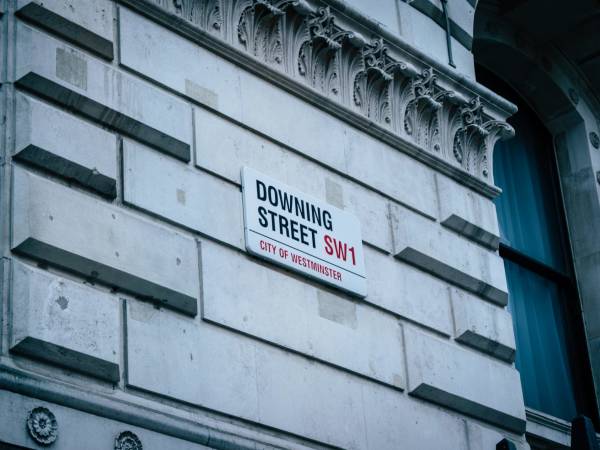
Behind the black iron gates in front of you is Downing Street, and a short way down it is Number 10, home and office of the British Prime Minister. The street is named after George Downing, a diplomat who switched sides just in time when the monarchy returned in 1660. He put up a row of cheap houses on boggy ground. Centuries later, Winston Churchill grumbled that they were shaky and lightly built by the profiteering contractor whose name they bear. The first Prime Minister, Robert Walpole, was offered the houses as a gift from the King. He turned down the personal present and asked that they become the official home of everyone who held his post after him. It has been the Prime Minister's official home ever since. Notice the black front of Number 10. The bricks are actually yellow. Two centuries of coal smoke turned them black, and when they were finally cleaned, they were painted black again to keep the look everyone knew. Until the nineteen eighties, anyone could walk up and stand outside the famous door. Inside lives Larry, a former stray cat and official Chief Mouser, who has served every Prime Minister since David Cameron. Next stop: the Churchill War Rooms, about 350 metres or 5 minutes. Carry on down Whitehall, turn right into King Charles Street and head for the steps at the far end.

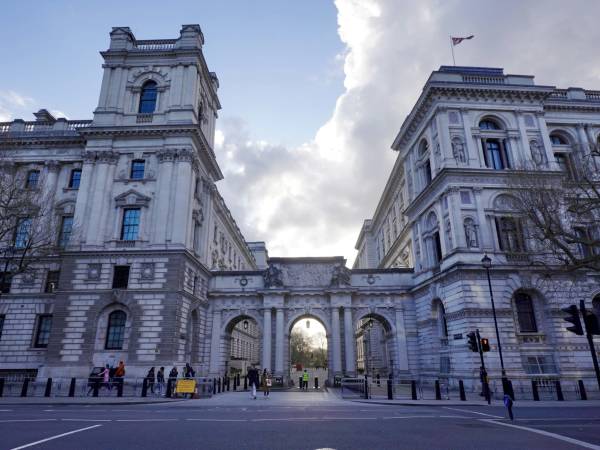
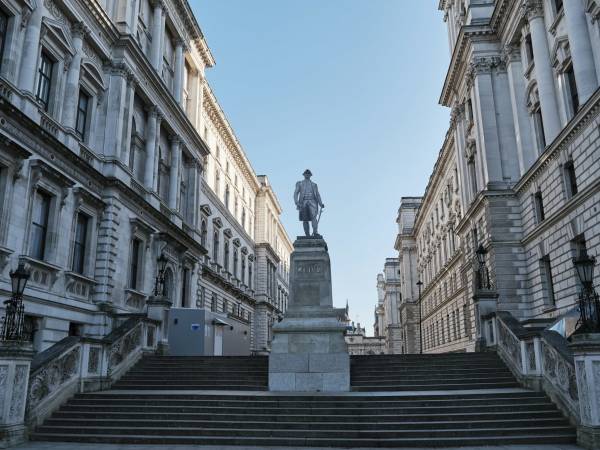
You're at the foot of Clive Steps, below a vast government building. Underneath it, in the basement, are the Churchill War Rooms, the bunker from which Britain was run through the Second World War. The rooms were ready on the twenty-seventh of August 1939, a week before Britain declared war. Churchill's War Cabinet met down here more than a hundred times. A concrete slab up to three metres thick was later added overhead, but a big enough bomb could still have broken through. The heart of the bunker was the Map Room. Pins on the charts showed where every ship and convoy was, and when a ship was sunk, its pin came out. One map is pocked with hundreds of thousands of tiny holes. On D-Day, Churchill spent the whole day watching it, because the King had stopped him from going to sea to see the landings himself. The day after Japan surrendered in August 1945, the Map Room lights were switched off for the first time in six years. The door was shut and everything left as it was. One officer had even left his sugar ration in a desk drawer. It was found decades later. Next stop: Big Ben and the Houses of Parliament, about 500 metres or 6 minutes along Horse Guards Road, then left on Great George Street to Parliament Square.

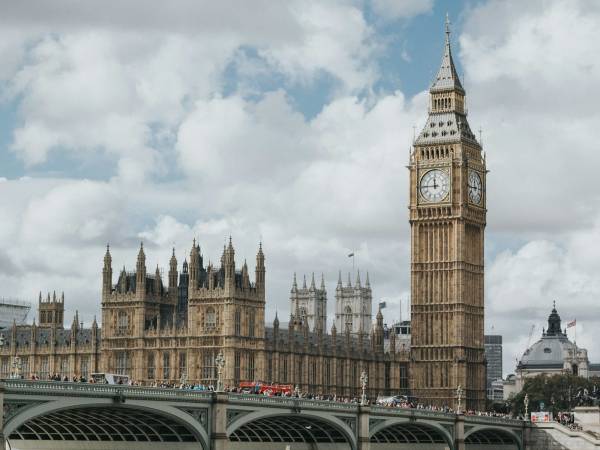
You're on the corner of Parliament Square, with the clock tower and the Houses of Parliament straight ahead. Most of what you see exists because someone tidied up a little too eagerly one October day in 1834. For centuries, the Treasury had kept its accounts on wooden sticks cut with notches, a kind of medieval receipt. When the system was finally abolished, two cartloads of old sticks were left over. They were burned in the furnaces beneath the House of Lords. The furnaces overheated, and the fire spread through almost the entire old palace. Only medieval Westminster Hall was saved. It's on the right of the front. The new palace was designed by Charles Barry, with a young Augustus Pugin drawing almost every detail. Big Ben is really the name of the great bell inside the tower, not the tower itself. The first bell cracked during testing. The second cracked too, just months after it started striking. The fix was to turn it a quarter round and give it a lighter hammer. It still rings with that crack today. Look right to the top of the tower. If the lantern up there is lit after dark, Parliament is still sitting. Next stop: Westminster Abbey, about 300 metres or 4 minutes across Parliament Square to the west entrance.

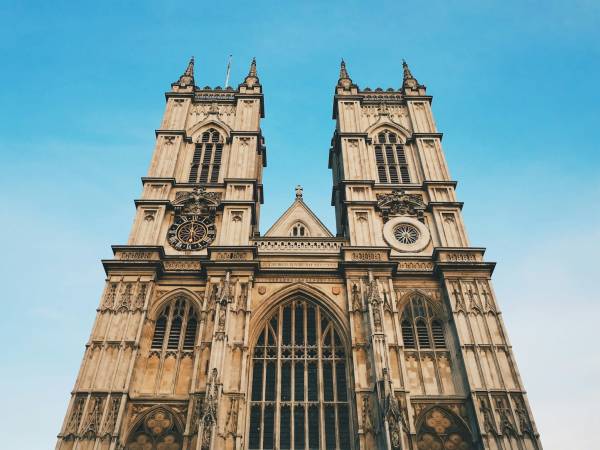
You're standing in front of the west entrance of Westminster Abbey, the church where English and then British monarchs have been crowned for almost a thousand years. The very first coronation here nearly ended in chaos. On Christmas Day 1066, William the Conqueror was crowned, just weeks after the Battle of Hastings. Inside, the congregation shouted their approval of the new king, in English and in French. But the Norman guards outside thought the shouting meant William was under attack, and set fire to the houses nearby. The church filled with smoke and most people fled. William and the clergy stayed put and finished the service. Look up above the door. There's a row of ten statues. The niches were made in the Middle Ages, but stood empty for around five hundred years. In 1998 they were filled with martyrs of the twentieth century, people who died for their faith. Fifth from the left is Martin Luther King. Just inside this door is the Coronation Chair, made for King Edward the First around 1300. It's covered in graffiti carved by schoolboys and visitors. One of them boasted that he had slept in the chair on a July night in 1800. Next stop: the London Eye, about 1 kilometre or 15 minutes. Head back past Parliament Square, cross Westminster Bridge and turn left along the river. Look back from the bridge for the classic view of Parliament.

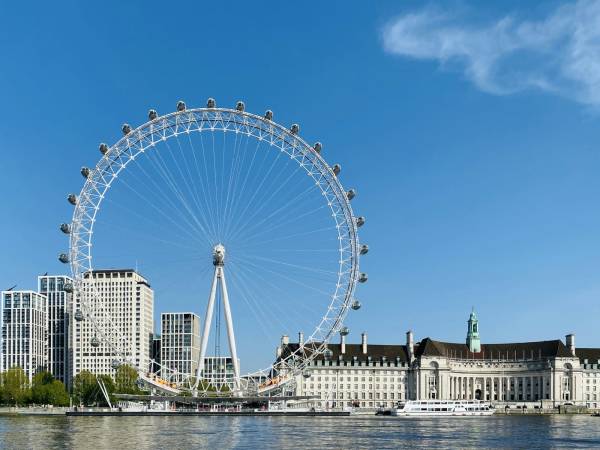
Towering over you is the London Eye, the giant wheel on the Thames. It stands 135 metres tall, and one turn takes about half an hour. It exists because an architect couple lost a competition. David Marks and Julia Barfield entered the idea in a newspaper's search for a landmark to mark the new millennium. The judges decided there would be no winner at all. The couple didn't give up. They got planning permission on their own, and Marks even mortgaged his house to cover the early costs. The wheel was assembled lying flat out on the river, then hauled upright. The first attempt had to be abandoned when cables slipped. A month later, it finally stood straight. Look at how it's held up. The whole wheel, around sixteen hundred tonnes, hangs from one side only, on a leaning frame over the water. Its spokes are cables, just like a bicycle wheel. The Eye was only meant to stand for five years. Later it was given permission to stay for good. Count the capsules if you like. There are thirty-two, one for each London borough. But there is no number thirteen. Next stop: the Oxo Tower, about 1.1 kilometres or 15 minutes east along the river, past the Southbank Centre and under Waterloo Bridge.

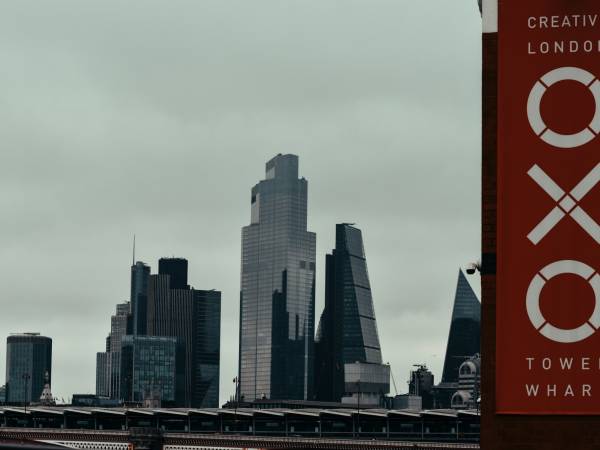
Look up at the tower on the building in front of you. The windows near the top make three shapes, a circle, a cross and another circle. They spell OXO, on all four sides. That's no accident. In the 1920s, the company behind the Oxo stock cube bought an old power station here on the South Bank. It wanted a huge illuminated sign on the top. Permission was refused, because advertising against the skyline was banned along this stretch. So the architect designed windows that just happened to spell out the brand name instead. The rules said nothing about windows. The product had German roots. The chemist Justus von Liebig developed a meat extract in the nineteenth century, and the first Oxo cubes went on sale in 1910, at a penny each. Later the building fell into ruin. By the nineteen seventies it was derelict. In the end, a not-for-profit group run by local people was allowed to buy the land. They restored the building and filled it with cooperative flats, shops and studios for designers. Step into the arcade along the river. It opened in 1988, part of the same rescue. Next stop: Tate Modern, about 600 metres or 8 minutes further along the river, under Blackfriars Bridge.

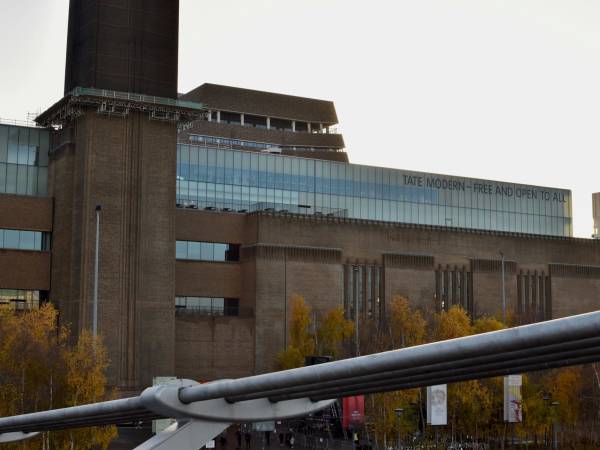
The huge brick building in front of you looks more like a factory than a museum. That's because it was a power station. Today it's Tate Modern, London's great gallery of modern art. Its architect was Giles Gilbert Scott, the same man who designed London's red telephone box. The power station went up after the Second World War, using more than four million bricks, and its river front stretches over two hundred metres. Look at the chimney in the middle. It's ninety-nine metres tall, and it was deliberately kept lower than the dome of St Paul's Cathedral across the river. Turn around and compare them for yourself. A power station was not supposed to outshine the cathedral. The station shut down in 1981 and stood empty for years. When it was turned into a gallery, the Swiss architects Herzog and de Meuron decided to change as little as possible. The old Turbine Hall became a vast indoor street, and the glass box along the roof is almost the only addition you can see from outside. The gallery opened in 2000 and is now the most visited art gallery in Britain. Next stop: the Millennium Bridge, right next door.

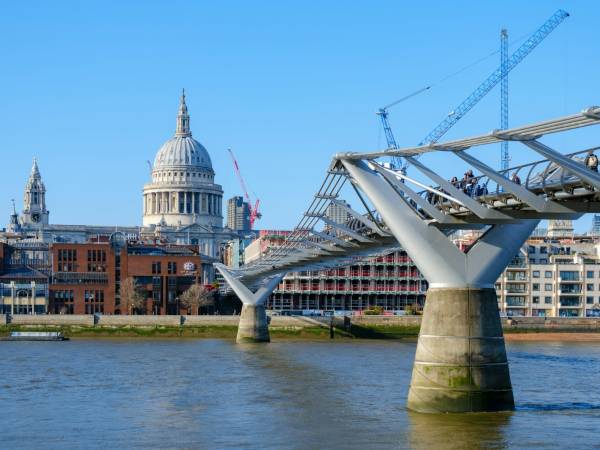
In front of you is the start of the Millennium Bridge, the slim steel footbridge that points straight at the dome of St Paul's Cathedral. It opened in June 2000, and around ninety thousand people crossed it on the first day. Then it began to sway. As the deck moved slightly sideways, walkers unconsciously fell into step with it, which made it swing even more. Two days later it was closed. It took almost two years and dozens of shock absorbers to fix. Londoners still call it the Wobbly Bridge. Now look at the dome. Christopher Wren built the cathedral after the old one burned down in the Great Fire of 1666. On the night of the twenty-ninth of December 1940, it stood in the middle of a second great fire. German incendiary bombs rained down on the City, and almost thirty of them hit the cathedral or landed close by. One burned through the lead of the dome, but fell outwards and was put out. Volunteer firewatchers stayed on the roof all night. A photographer caught the dome rising above the smoke. That picture became the symbol of a city that refused to give in. Next stop: Shakespeare's Globe, right next door. Look for the round white building with the thatched roof.

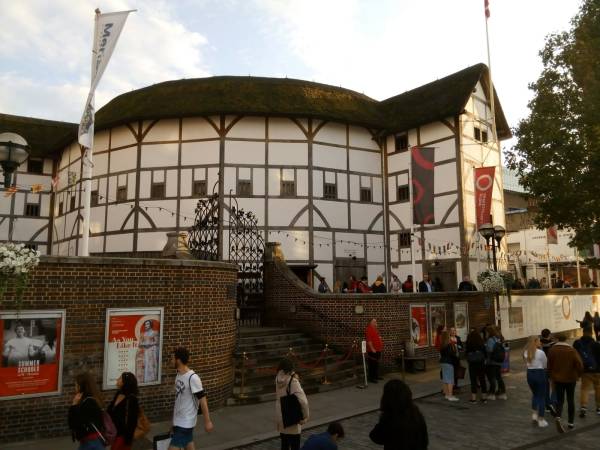
The round, white building with the thatched roof in front of you is Shakespeare's Globe, a reconstruction of the theatre where many of his plays were first performed. The original Globe was built from stolen timber. Over Christmas 1598, while their landlord was away, the actors pulled down their old playhouse north of the city. They carried the timber across the Thames and put up a new theatre here on the south bank. In 1613 it all went wrong. During a performance, a stage cannon was fired and a spark caught the thatch. Within about an hour, the theatre was gone. Nobody died. One witness wrote that a man's breeches caught fire, and he put them out with a bottle of ale. The theatre you see now exists thanks to the American actor Sam Wanamaker. Disappointed to find the original site marked only by a small plaque, he spent decades getting the Globe rebuilt. He died a few years before it opened. Look up at the roof. It's the only thatched roof in London, and it needed special permission. After the Great Fire of 1666, thatch was banned in the city. Next stop: the Golden Hinde, about 600 metres or 8 minutes. Follow Bankside east, under Southwark Bridge, and into narrow, cobbled Clink Street.

The ship in front of you is a replica of the Golden Hinde, which Francis Drake sailed around the world between 1577 and 1580. It was the first English ship ever to do it. She actually set out as the Pelican. Halfway through the voyage, Drake renamed her to flatter his main backer, whose family crest showed a golden hind, a female deer. Off the coast of South America he captured a Spanish ship loaded with silver and gold, one of the richest prizes anyone had ever taken. Only fifty-six of the eighty men who set out came home. Queen Elizabeth the First came aboard to knight him. But she had the French ambassador perform the ceremony itself. The real ship eventually rotted away, but a chair made from her timbers survives in Oxford. This replica is no museum prop. She was built by hand using traditional methods, and has sailed around the world herself. The street running west from here is Clink Street. The Bishop of Winchester's prison stood here, known as the Clink. The name probably comes from the clink of iron, and it lives on in English. If you're in prison, you're in the clink. Next stop: Borough Market, right next door, just round the corner on Cathedral Street.

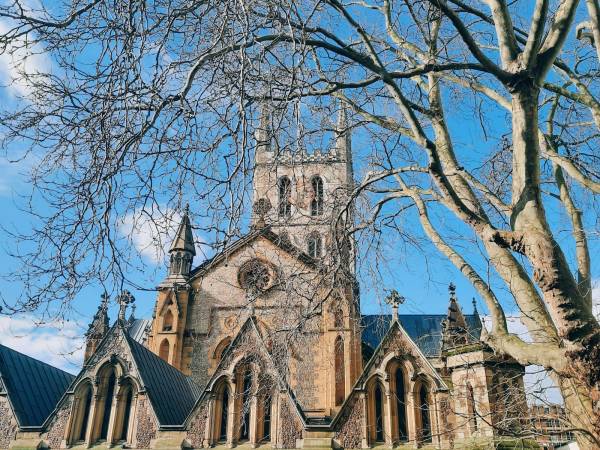
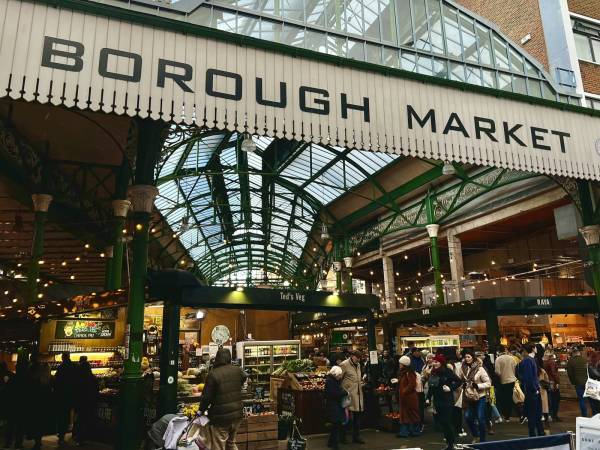
You're at the edge of Borough Market, one of London's oldest food markets. Food has been traded here in Southwark for around a thousand years. The market has survived plenty of attempts to get rid of it. In the thirteenth century, the City of London banned its citizens from buying food here, on the "wrong side of the river". In the eighteenth century, Parliament decided to close it because it was blocking the high street. So the locals clubbed together, raised six thousand pounds and bought a plot of land where the market could move. The same charitable trust still runs it today. Look up. The railway runs over your head. In the nineteenth century a viaduct was cut straight through the market, and trains still rumble over the stalls. For a long time this was a wholesale market for fruit and vegetables, and when supermarkets arrived it nearly died. Around the year 2000 it was reborn as a market for good food, and today it's one of the most popular places to eat in the city. The church next door is Southwark Cathedral. Local merchants bought it from the King in 1611, and Shakespeare's brother Edmond is buried there. Next stop: London Bridge, about 350 metres or 6 minutes. Take the steps up to Borough High Street and walk out onto the bridge. The stop is in the middle.

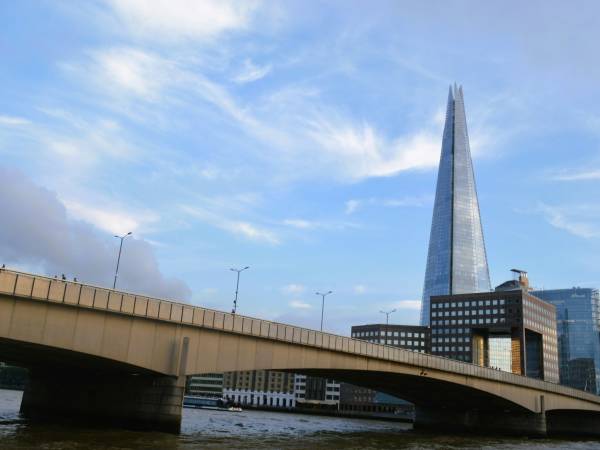
You're standing on London Bridge. It may not look like much, but there has been a bridge on this spot for almost two thousand years, ever since the Romans founded the city. According to the Norse sagas, one of the early bridges was pulled down by a Norwegian. In 1014, Olav Haraldsson, who later became King of Norway, is said to have tied ropes from his ships to the bridge and rowed away until it collapsed. Some say that's where the nursery rhyme London Bridge is Falling Down comes from. It's a legend, but a good one. Later came a stone bridge that stood for about six hundred years. It was crowded with houses, some of them six storeys high. Above its gatehouse, the heads of traitors were displayed on poles. Among them were William Wallace and Thomas More. The bridge before this one ended up across the Atlantic. In 1968 it was sold to an American businessman and shipped, stone by stone, to a desert town in Arizona, where it still stands. Look downstream. That's Tower Bridge, the one people often mistake for London Bridge. Next stop: the Monument, about 400 metres or 5 minutes. Cross to the north side and walk up Fish Street Hill. Look for the golden flames.

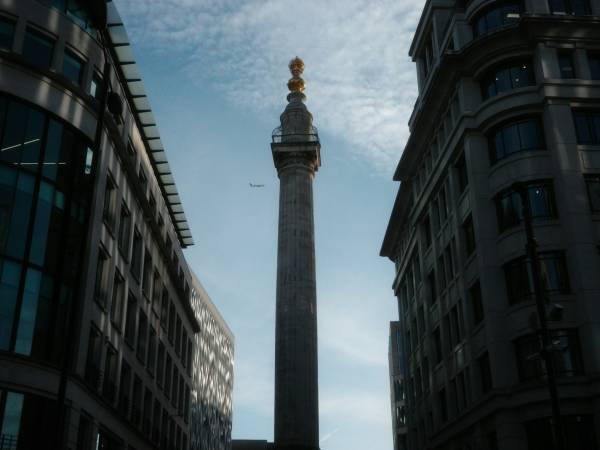
The tall column with the golden flames on top is the Monument, built to remember the Great Fire of London in 1666. The fire started in the early hours of the second of September, in a bakery on Pudding Lane, just a few steps east of where you're standing. It burned for days and left most of the medieval city in ashes. The column is sixty-one metres tall, and the distance from its base to the site of the bakery is exactly the same. If it toppled over to the east, its tip would land roughly where the fire began. It was designed by Christopher Wren and the scientist Robert Hooke. Hooke wanted it to be a scientific instrument too. The column was meant to work as a giant telescope, and there is a small laboratory hidden underneath. The plan was dropped. Traffic in the streets made the ground shake too much. Look at the carved panel on the west side of the base. It shows King Charles the Second directing the rebuilding of the city. You can also climb to the top. There are 311 steps to the viewing gallery, and everyone who makes it gets a certificate. Next stop: the Tower of London, about 600 metres or 9 minutes east along Lower Thames Street.

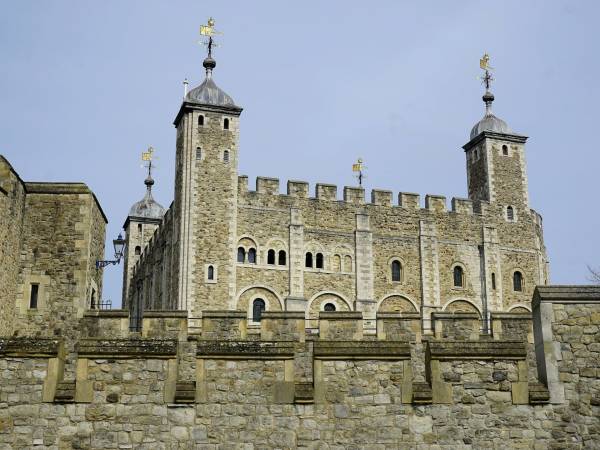
In front of you, beyond the moat, is the Tower of London. The big square keep in the middle is the White Tower. William the Conqueror began building it around 1078, using stone shipped from Normandy, to show Londoners who was in charge now. The Tower has been a fortress, a palace and a prison. Anne Boleyn, Lady Jane Grey and the young Princess Elizabeth were all held here. The first prisoner escaped in 1101, down a rope that had been smuggled in inside a cask of wine. The cheekiest story belongs to Colonel Thomas Blood. In 1671 he attacked the keeper of the Crown Jewels and made off with the crown and the orb. He was caught before he got away. Instead of being executed, he was pardoned by King Charles the Second and given land in Ireland. Nobody is quite sure why. The Crown Jewels are still here. So are the ravens. Tradition says at least six must always live at the Tower. If they ever leave, the fortress and the kingdom will fall. Look down into the moat. It was filled with water for centuries, until it was drained in the 1840s after an outbreak of disease. Next stop: Tower Bridge, about 500 metres or 5 minutes. Head down to Tower Wharf and follow the river, with the bridge right in front of you.

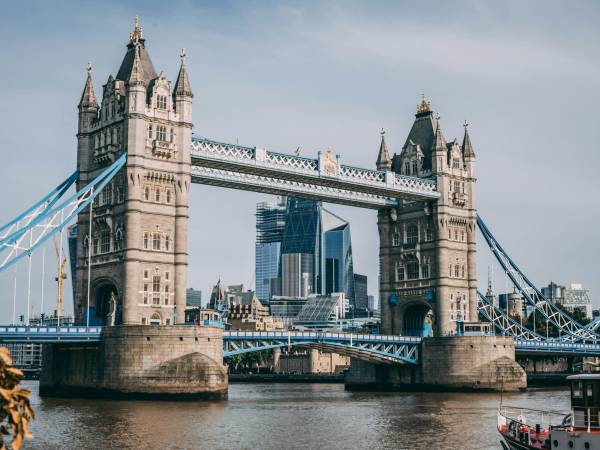
You're on the riverside in front of Tower Bridge. It opened in 1894. London Bridge was choked with traffic, and the city needed a new crossing that would still let ships through to the docks. The answer was a bascule bridge, from the French word for seesaw. The two halves of the road can rise in about a minute, and until 1976 they were powered by steam. The towers were given a Gothic look to match the Tower of London next door. One December day in 1952, bus driver Albert Gunter was driving a red double-decker over the bridge when the road beneath him began to rise. Too late to stop, he put his foot down and jumped the gap to the other side. He was rewarded with ten pounds and a day off. Look up at the two high walkways between the towers. They closed in 1910 because people preferred to wait down at street level rather than climb all those stairs. Today they have glass floors. From here you can take in two thousand years of London, from the Conqueror's White Tower behind you to the Shard rising across the river. That's the end of your London tour. Thanks for exploring with us. Want to keep going? Open the app to see the tours closest to you, right at the top of your home screen. And tell us what you thought. There's a short feedback option on your screen right now, and it goes straight to the people who made this tour. Guide to Go. Putting stories into your ears since 2017.