0
Get to know Tromsø on foot, at your own pace. This guide takes you through the city centre and out to some of its best-known places, from Roald Amundsen and the polar history by the harbour to the cathedral, Skansen and Ølhallen, the old beer hall. Across the sound you'll find the Arctic Cathedral and the cable car, and near the university the botanic garden and the science centre. Walk in any order you like. Each story starts by itself when you reach a point, and you can also listen from anywhere by tapping the points on the map. Nineteen stops, with stories of trappers, polar explorers, kings and the people who built a town on the edge of the Arctic Ocean.

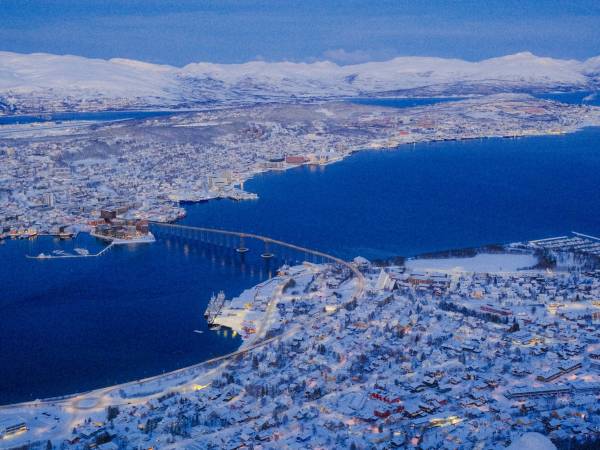
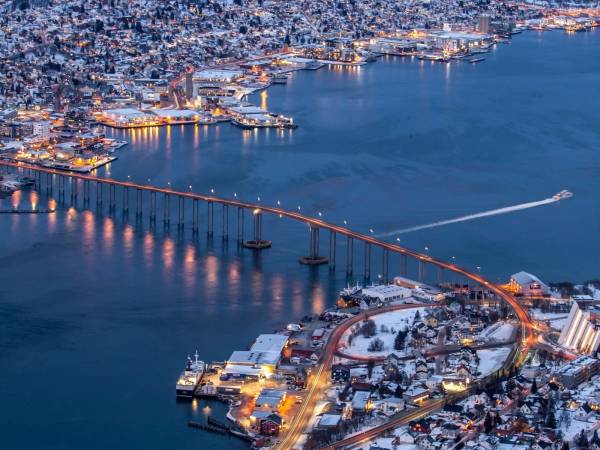
Welcome to Tromsø, and to this audio guide. You're on Tromsøya, an island in a narrow sound, about 350 kilometres north of the Arctic Circle. Tromsø became a town in 1794, and a few years later fewer than a hundred people lived here. Today the municipality is home to around 80,000. The guide works on its own. Walk through the centre in any order you like, and each story starts when you reach the place it is about. You can also tap a point on the map and listen from wherever you are. Up here the light runs to extremes. From late November to mid-January the sun stays below the horizon, and from late May to late July it never sets. In the 1800s the merchants' wives followed Paris fashion so closely that Tromsø, it is said, became known as the Paris of the North. Start wherever you are.

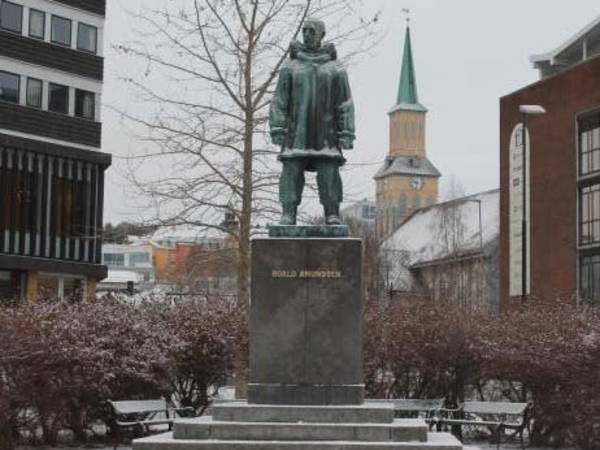
You're on Roald Amundsen Square, a small triangular square by the harbour. Look at the statue. Amundsen has his back to the town and his eyes on the sound, which suits a man who was always on his way out. In 1911 he led the first expedition to reach the South Pole, and Tromsø was often his last stop before the ice. On the afternoon of 18 June 1928 he took off from the water here in a French flying boat, the Latham. He was going to search for the Italian airship Italia, which had crashed on the ice on its way back from the North Pole. Six men were on board. That evening the radio went silent, and none of them was seen again. The plaque to the right of the statue remembers them. In the north-east corner of the square is a quieter memorial. It carries the names of 17 Jewish men, women and children from Tromsø who were deported and murdered in Auschwitz. The youngest, Ruth Sakolsky, was two years old. Two memorials on one square, both for people who left this town and never came back. Only one of those stories was a choice.

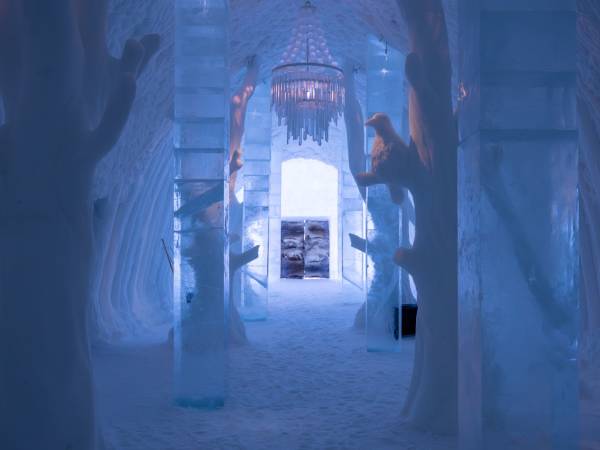
Behind these doors on Kaigata is Magic Ice, a bar where nearly everything is made of ice: the walls, the counter, the sculptures and the glass your drink is served in. It's built from several tonnes of Norwegian natural ice, which is why you're handed a warm poncho and gloves on the way in. The carvers took their theme from the square next door. The sculptures follow the polar explorers, Fridtjof Nansen and Roald Amundsen among them, and show what life in the Arctic once meant. One of the centrepieces is an expedition ship cut from clear ice. Stand next to it for a moment and think of the real thing. The men these sculptures honour spent whole winters in far colder conditions than this room, in huts of stone and earth, with no warm street waiting outside the door. Nansen and his companion got through one winter living on polar bear meat. Here you get a taste of that cold with a drink in your hand, and then you walk back out into town.

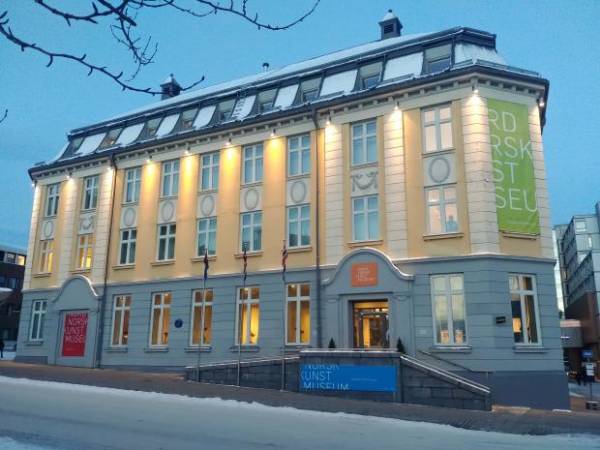
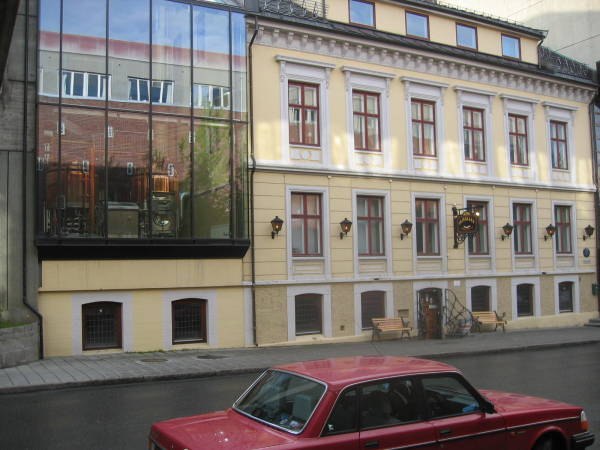
The pale building in front of you, with the steep mansard roof, is Nordnorsk Kunstmuseum, the art museum of Northern Norway. Look up at the plasterwork: a row of small blocks under the cornice, garlands and oval medallions. It was built during the First World War as the town's post and telegraph office, and for half a century letters and telegrams to and from the north passed through these rooms. Later it housed the police, and since 2002 it has been full of art. The museum itself began with almost nothing. When it opened in 1988, it rented a few rooms elsewhere in town and did not own a single work. Everything on the walls was on loan from the National Gallery in Oslo. Today the collection holds more than 2,000 works, from the 1600s to now, and Sámi art and duodji, traditional Sámi craft, make up a growing part of it. One painting many visitors look for shows the preacher Lars Levi Læstadius speaking to the Sámi. A fitting picture for a building that once carried the news of the north.

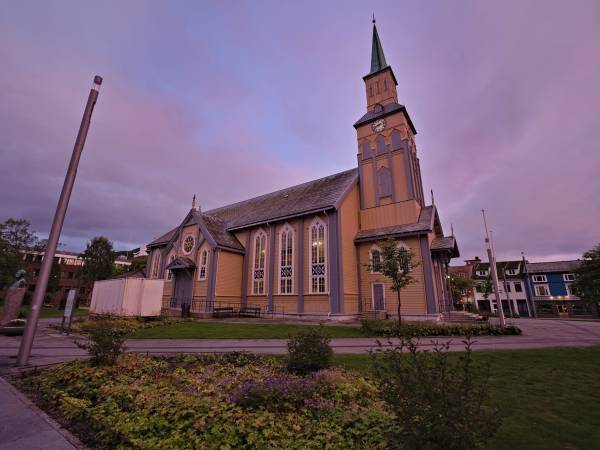
The yellow wooden church in front of you is Tromsø Cathedral, the only Protestant cathedral in Norway built of wood. It was consecrated in 1861, before it was even finished. The architect, Christian Heinrich Grosch, designed close to 80 churches, and this was one of his last. Look at the grey pilasters running up the walls. They're more than decoration. Behind them, iron rods hold the timber walls together. In the 1980s the church was found to be leaning, and more rods were added. The park around you is older than the church. From the Middle Ages until the 1800s this was the town's graveyard, and it hasn't quite let go of that past. When the park was dug up in 2017 and 2018, workers made 65 finds of human remains, and a gravestone, beneath the paths. Inside, above the altar, hangs a copy of Adolph Tidemand's painting of the Resurrection, made in 1884. Look out too for the medieval Madonna above the font. She links this church to the very first one that stood on this spot.

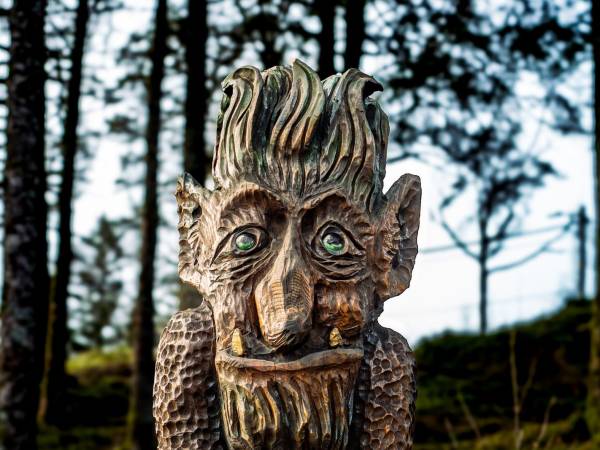
Up on the second floor of the big grey building by the harbour is the Troll Museum. It calls itself the first and only troll museum in Norway, and the way in is from Samuel Arnesens gate. Trolls are far older than the fairy tales most people know them from. In Viking-age belief they were dangerous beings of the mountains and forests, and the museum follows them all the way from those beliefs to the stories children still hear today. You'll also meet some relatives you may not know. The nøkk is a water spirit who lives in dark ponds and lakes. The fossegrim sits by waterfalls playing the fiddle. And Tromsø has its own sea troll, who gets a whole hall to himself, together with life in the sea and the Sámi. A moving sand table and augmented reality let you watch the trolls react to you. When you come back out, look up at the mountains around the town, and decide for yourself whether that rock up there really is just a rock.

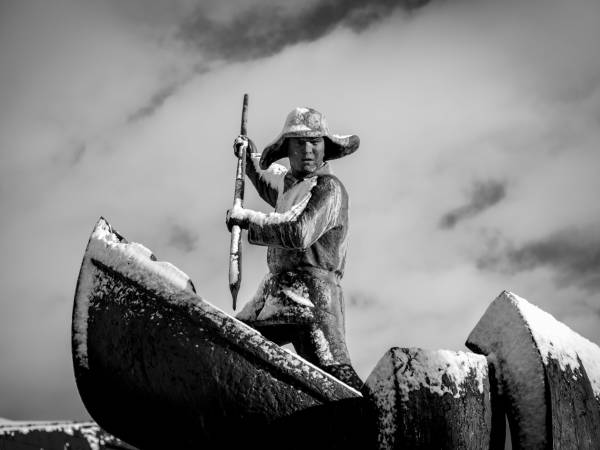
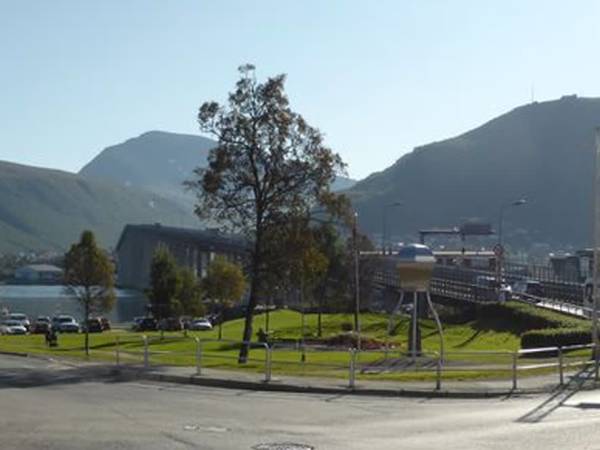
You're on Stortorget, the main square, where Tromsø has traded, met and celebrated for generations. Two things here deserve a closer look. The first is the little rocket-shaped kiosk. It dates from 1911, when an 18-year-old named Margit Løkke was given permission to open it. For decades it sold newspapers. Today it's a protected building, and since 2014 it has served beer as one of the smallest licensed bars in Norway, with room for hardly anyone inside. The second is the Hunting and Fishing Memorial, raised in 1984 by the Tromsø skippers' association. Its sculptor, Sivert Donali, had spent years restoring the stone saints on Nidaros Cathedral in Trondheim. The memorial honours the hunters and fishermen who died on the Arctic Ocean. One loss stands out. At Easter 1952, five sealing ships vanished in a storm in the West Ice, far out in the Arctic Ocean. Seventy-eight men died, 44 of them from Troms. No wreckage was found, and no call for help was ever heard. They left 46 widows and 98 children.

You're in City Hall Park, a small green space in the middle of town, and the statue here is of King Haakon the Seventh. It's the work of the sculptor Per Palle Storm and was unveiled in 1969. The King has a special bond with Tromsø. In the spring of 1940, as Germany invaded Norway, the King and the government moved north. For a few weeks in May and June, Tromsø was in effect the capital of free Norway, and the government met at the bishop's residence here in town. The King himself stayed in Målselvdalen, a valley further inland. On 7 June 1940 the King, Crown Prince Olav and the government left Tromsø on board the British cruiser HMS Devonshire, bound for exile in London. Five years later, to the day, the King came home to Oslo. Look around the park for a second bust. It shows Johannes Steen, who was once a headmaster here in Tromsø and later became Prime Minister of Norway.

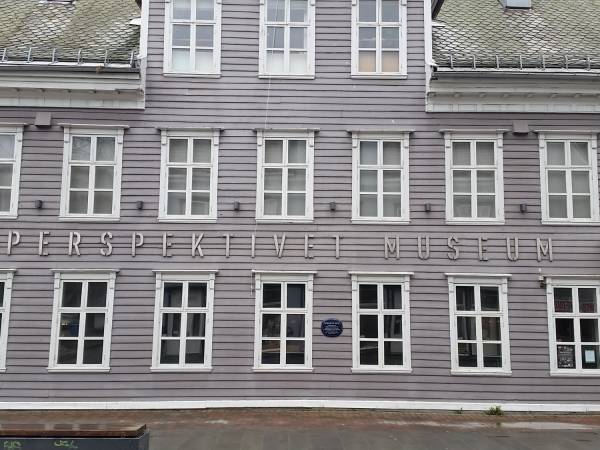
The fine house at Storgata 95 is Perspektivet Museum. It was built in 1838 as a merchant's home and has been protected since 1942. Notice the symmetrical front, typical of the Empire style of its day. From 1901 to 1905 a young woman named Sara Fabricius lived in an apartment here. She wanted to be a painter, trained in Kristiania, today's Oslo, and later in Paris, where she moved in 1906. Only much later did she start to write, under the name Cora Sandel. Her trilogy about Alberte, a young woman growing up in a small northern town, draws on her years in Tromsø, with the place names changed. The house has had other lives too. For ninety years from 1911 it was the People's House of the workers' association, with its own café. Today the museum tells stories through documentary photography among other things, and Sara is back. In 2017 her son gave 25 of her paintings to the museum. The girl who left for the wider world has a permanent place in the town again.

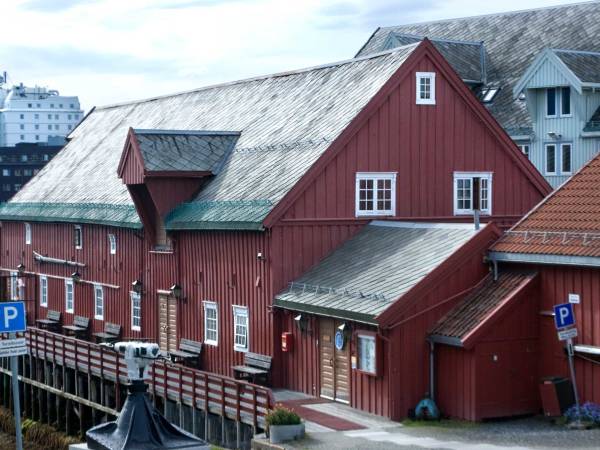
The old wooden warehouses in front of you, standing on piles over the shore, are the Polar Museum. The customs warehouse was built in the 1830s and is said to be the only old building in Tromsø still standing exactly where it was put up. The strip of beach below is the last original shoreline left in the centre. The museum opened on 18 June 1978, fifty years to the day after Roald Amundsen flew out of Tromsø and disappeared. Among the objects inside is a fuel tank from his plane, found the following year. But above all, this museum is about the people who went north to hunt and trap. Henry Rudi, born and buried in Tromsø, was known as the Polar Bear King. Between 1908 and 1948 he spent 27 winters in the Arctic. Wanny Woldstad from Sommarøy was the first woman taxi driver in Northern Norway, and in the 1930s the first woman to winter on Svalbard as a trapper in her own right. Inside you can also see a real trapper's hut, built in 1910 and brought here from Svalbard.

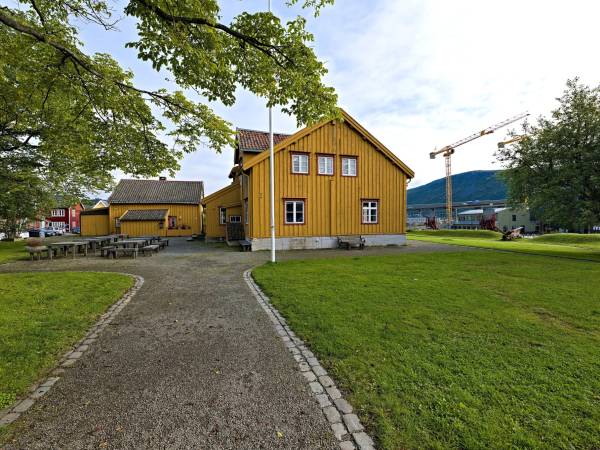
The grassy ring and the yellow buildings in front of you are Skansen, the oldest structure you can still see in Tromsø. The round earthwork is about 50 metres across, and three to four metres high on the outside. It's at least 800 years old, from the 1200s, when the Norwegian king was tightening his hold on the north in a struggle with Novgorod and the Karelians to the east. Back then this was a headland with sea on three sides and a moat on the landward side. Since then the land has risen, and today Skansen sits well back from the water. Even in the 1700s, nobody knew who had built it. An army officer, Peter Schnitler, wrote in 1743 that an old legend said it was raised because of the Russians. Around 1990, archaeologists found an iron arrowhead lodged in the rampart, a sign the fort may once have come under attack. The yellow customs house on top came much later, around 1790. Since then it has been a school, an epidemic hospital, an old people's home and a museum.

You're on Fridtjof Nansen Square, where Tromsø Bridge comes down into the city centre. In the park here is a bust of Nansen, the explorer, scientist and humanitarian, unveiled in 1961. Nansen's bond with Tromsø comes from a single summer. In 1893 he set out in the ship Fram, planning to let her freeze into the ice and drift across the Arctic Ocean. In March 1895 he and Hjalmar Johansen left the ship on skis to try for the North Pole. They reached 86 degrees north before turning back, then spent the winter on Franz Josef Land in a hut of stone and earth, living on polar bear meat. In August 1896, Nansen reached Vardø on the very day that Fram broke free of the ice. Eight days later, on 21 August, the whole expedition was reunited here in Tromsø, and crowds turned out to greet them. Nansen went on to receive the Nobel Peace Prize for 1922, for his work for prisoners of war, refugees and the starving after the First World War.

You're outside Ølhallen, the beer hall, Tromsø's oldest pub. It opened in 1928 in the cellar of the Mack brewery. Ludwig Mack, a baker, had founded the brewery in 1877, hoping beer would tempt people away from strong spirits. For decades this was the first stop for trappers coming home from the Arctic, with farmers and townspeople alongside them. Henry Rudi, the Polar Bear King, was a well-known regular. It was very much a man's world. Women were not welcome, there was no ladies' toilet, and wives sent messages in to their husbands through people walking past. Female students and nurses finally broke the tradition in the late 1960s. Today there are around 70 taps of Norwegian beer, and a stuffed polar bear keeps an eye on the room. Ask for a blanding, the regulars' mix of two parts dark beer to one part pilsner. Most of Mack's brewing moved out of town to Nordkjosbotn in 2012, but beer is still made right next door at Mack's microbrewery. Look for the bust of Ludwig Mack outside.

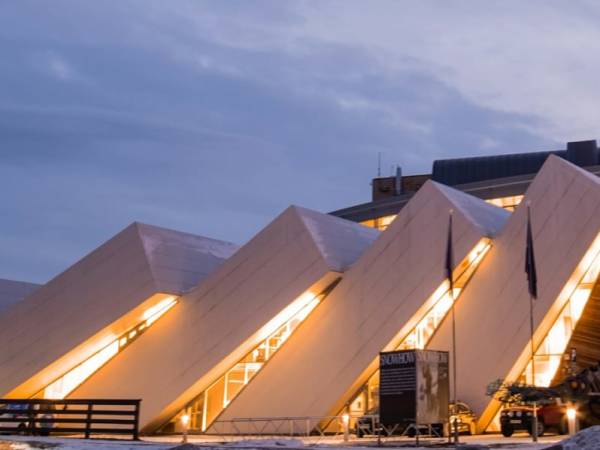
The building that looks as if it has toppled over is Polaria. Look at the five panels leaning in towards the land. They're meant to be ice floes, pushed ashore by the sea. Polaria opened in 1998 and is often called the world's northernmost aquarium. The stars live in the pool. There are seven seals of three species, and every one of them has a name. Bella and Mai San are bearded seals, both born on Svalbard in 2003. The keepers call Bella the diva, and Mai San goes by Oops. Vlad, another bearded seal, came from Brest in France and is named after Vladivostok. In July 2023 the harbour seals Lyra and Loffen had a pup, Leo, the first seal ever born at Polaria. Inside, you can look up at them through glass domes beneath the pool, or walk through a glass tunnel under the water. The curved building next door went up at the same time. Today it houses the Fram Centre, where scientists study the Arctic.

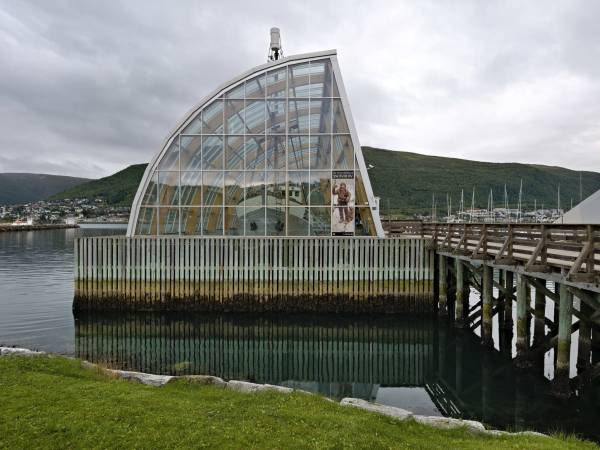
Next to Polaria, inside a building of her own, sits MS Polstjerna, the Pole Star. The university museum calls her Norway's best-preserved sealing ship. She was built in Risør in 1949 for a Tromsø skipper, Halfdan Jacobsen, and on her very first trip she brought home 3,610 seals. Sealing was hard and dangerous work. Every spring the crew sailed in late March for the hunting grounds known as the West Ice and the East Ice, and didn't come home until May or June. Over 33 seasons Polstjerna took more than 97,000 seals. She also rescued the crews of ships that sank in the ice. Almost everything on board is original: the charts in the wheelhouse, the mess where the men ate, the rigging and the small boats they hunted from. In 2003 she was hauled into a dry dock here, and the building was put up around her. Notice how small she is. Then picture a full crew living on board, week after week, with ice on every side.

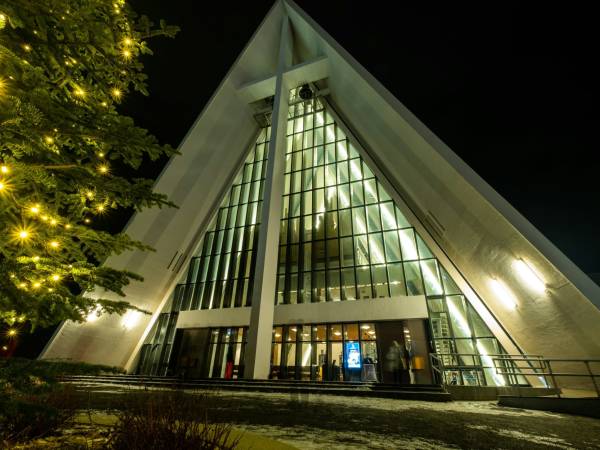
Across the sound, in Tromsdalen, stands the church everyone photographs: Ishavskatedralen, the Arctic Cathedral. Officially it's Tromsdalen Church. It was consecrated in 1965, and despite the name it isn't a cathedral at all. The architect, Jan Inge Hovig, built it as a row of panels, eleven on each side, in the shape of a traditional boathouse. To many people the panels look like ice floes, which is where the nickname comes from. Hovig himself spoke of the northern lights, the shapes of the mountains and the long polar night. Then something happened that he hadn't planned. In 1972 a huge glass mosaic by Victor Sparre was set into the east wall. It shows the hand of God sending out three rays of light: one through the risen Christ, one through a woman and one through a man. But it blocked the view Hovig had wanted, straight through the church to the peak of Tromsdalstinden. The organ has almost 3,000 pipes, and its bellows are made of reindeer hide. Look at the west front too, where a tall concrete cross stands behind the glass.

Above you, the cabins glide up the mountainside. Fjellheisen, the Tromsø cable car, has carried people from Tromsdalen up to Storsteinen since 1961. The ride takes four or five minutes, and at the top you're 421 metres above the sea, with Tromsøya and the sound spread out below. If you'd rather earn the view, there's another way up. Sherpatrappa, the Sherpa Steps, climbs more than 1,200 stone steps from the road below to the upper station, a rise of over 300 metres. The steps were built by Sherpas from the Khumbu region of Nepal, the area below Mount Everest. They spent around three years laying them, mostly with local stone. Behind the upper station, the mountain keeps climbing towards the summit of Tromsdalstinden, 1,238 metres high. In winter, many people come up here hoping to see the northern lights. In summer you can stand at the top at midnight with the sun still in the sky.

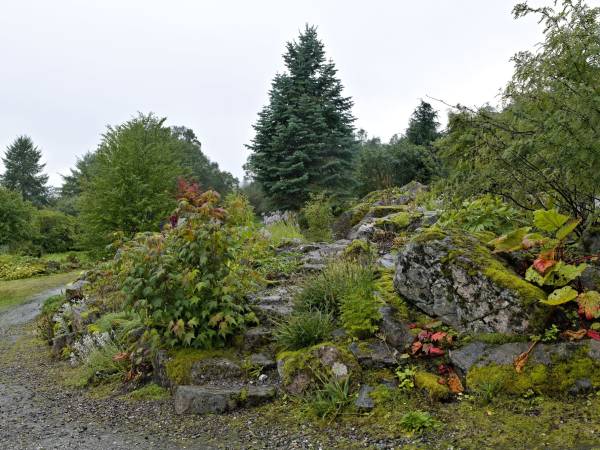
You're in the Arctic-Alpine Botanic Garden, the northernmost botanic garden in the world. It belongs to the university museum and opened in 1994, on land that was once a farm. The farm's last owner was Hansine Hansen, a teacher. She gave the property to be used for education, and the café here carries her name. Look around and you'll see plants that seem out of place this far north. More than 7,000 species from cold and mountainous regions all over the world grow here, in a garden of roughly 200 by 200 metres. The garden is known for its poppies, including the blue Himalayan poppy. Look for the Svalbard collection as well. One small buttercup in it, Ranunculus wilanderi, is critically endangered and known in the wild from a single site on Svalbard. This isn't an easy place to garden. The icy winter of 2009 to 2010 killed many of the plants. From late autumn until spring the whole garden sleeps under snow, and it wakes again when the snow melts in May.

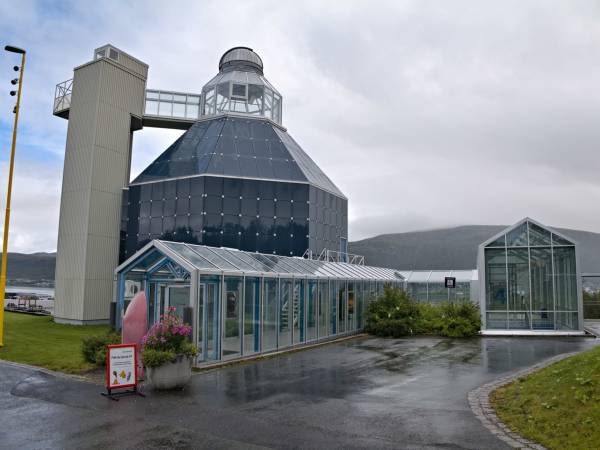
The building in front of you is Nordnorsk vitensenter, the Science Centre of Northern Norway, on the university campus. Inside are close to 100 hands-on installations over three floors, made for touching, testing and getting things wrong. The main draw is under the dome. The planetarium here is the largest in Norway, and when it was built it was the country's first planetarium open to the public. The centre says it was also the first in the world to show the northern lights filmed in timelapse. The aurora keeps no timetable, and cloud can hide it for days on end. Here the film plays every day, whatever the weather, on a dome more than twelve metres across. In 2023 a record of almost 19,000 people came to watch it. If the sky stays grey during your stay, this is the most reliable way to see the northern lights in Tromsø. And if the clouds do part, you'll know exactly what to look for. That's the end of this guide to Tromsø. If you've visited the other points, thank you for walking the town with us. If not, they're all waiting on the map, in whatever order suits you. And on the next clear night, look up.