0
Walk the moats, gates and stone walls of old Edo Castle, the seat of the shoguns, now the home of Japan's Emperor. Twenty short stories take you from Tokyo Station around the Imperial Palace: a samurai assassination in the snow, the rebel whose head is still feared in Otemachi, the ninja who guarded Hanzōmon and the gate where the Beatles fans went in. Walk the stops in any order. Eighteen stops work at any hour of the day or night; two bonus stops lie inside the East Gardens, which are open in the daytime.

Welcome to this historic walk around the Imperial Palace. Over the next couple of hours you'll follow the moats, gates and stone walls of what was once Edo Castle, the seat of the shoguns. Each story starts by itself when you reach a stop, so walk in any order you like. Two stops lie inside the East Gardens, which open in the daytime only. Everything else you can visit at any hour. Your first story is right here. Take a look at the long brick front of Tokyo Station. It opened in 1914, designed by the architect Tatsuno Kingo, and it stretches about 350 metres. In May 1945, an air raid burned out its domes and most of the top floor. After the war it was patched up with two storeys and plain, angular roofs, and in the 1980s there were plans to tear it down. People campaigned to save it. In 2012 it reopened as it looked in 1914, domes and all. Look closely at the top floor. The new bricks were fired specially so they would match the old ones below.

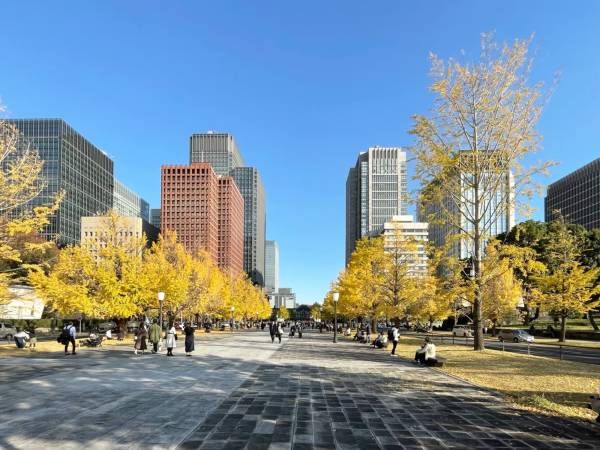
You're standing on Gyōkō-dōri, the broad avenue that links Tokyo Station with the palace. Gyōkō means an emperor's journey, and that is exactly what it was built for. After the great earthquake of 1923, Tokyo was being rebuilt, and this avenue was laid out between 1924 and 1926 for the emperor's trips between his palace and the station. It still has a ceremonial job. When a new ambassador arrives in Japan, they ride from the station down this avenue in a horse-drawn carriage, on their way to present their credentials to the Emperor. Most of the carriages are around a hundred years old. Very few countries still welcome diplomats like this. In bad weather, a limousine takes the carriage's place. Look down the middle of the avenue. The central lane was once kept for imperial journeys and ambassadors' carriages alone. Since 2010 you can walk on it too, except when a procession passes. The trees on either side are ginkgos, the official tree of Tokyo. And if you look towards the station end, you'll see its brick front framed perfectly at the end of the avenue.

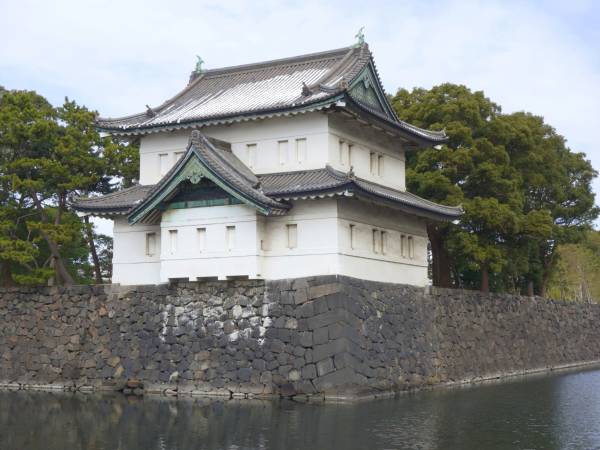
You're in Wadakura Fountain Park, on the edge of the old castle grounds. The name Wadakura goes back to the storehouses, or kura, that once stood near the gate here. The storehouses vanished long ago, but the name stayed. The fountains are much newer, and they were a kind of wedding present. The park was built in 1961 to celebrate the marriage of the Crown Prince, who later became Emperor Akihito. More than thirty years later it was renewed for the wedding of his son, the current Emperor. Look at the shape of the water jets. They are designed to recall the chrysanthemum, the flower of the imperial crest. In the evening the fountains are lit from below. Now look west, across the moat. On the corner of the old stone wall stands a white, two-storey turret. This is Tatsumi-yagura, a watchtower from the castle's days, and the only one left in this outer ring of the castle. With the wall and the water beneath it, it gives you a good idea of how Edo Castle once looked from the city.

Between the office towers of Ōtemachi sits a small, quiet plot. This is the Kubizuka, the mound for the head of Taira no Masakado. Masakado was a warrior who rose up against the government in the tenth century and declared himself a new emperor. He was killed, and his head was put on display in Kyoto. According to legend, it refused to die. For months its eyes stayed open and it cried out for its body, so it could fight again. Then it flew east and fell to earth right here. Centuries later, the Ministry of Finance moved onto this site. After the earthquake of 1923, the mound was levelled to make room for temporary offices. Within two years the finance minister and other officials had died, and talk of a curse spread. A memorial stone was quickly put up. In 1940, lightning set the ministry building on fire. After the war, a bulldozer clearing the site is said to have overturned, killing its driver. Even the national tax authorities, who tell this story themselves, say the curse cannot be proven. But look around. The mound is still here, and the city has built around it.

In front of you, across the bridge, is Ōte-mon, the main gate of Edo Castle. This was the front door to the shogun's world. Imperial envoys arrived this way, the shogun himself came and went through it, and the great lords, the daimyō, crossed this bridge when they came to report to the castle. The gate was built to impress, but also to trap. Look closely and you'll see it is really two gates. First a smaller one, then, set at a right angle behind it, a large two-storey gatehouse. Anyone who forced the first gate would find himself boxed into a square courtyard, with defenders firing down from above. The gatehouse you see is not the original. It burned in an air raid in April 1945 and was rebuilt in the 1960s. Inside, beyond the gate, an ornament from the old roof is kept, a mythical fish dated 1657. Today Ōte-mon is the main way into the East Gardens, open in the daytime. But whatever the hour, pause on the bridge for a moment. This is the view the daimyō had as they arrived.

You're standing where one of the most famous corridors in Japanese history once ran. Look for the small stone marker among the trees. Nothing else is left, but in 1701 a wooden passage about fifty metres long stretched through here, its sliding doors painted with pine trees. It led to the hall where the shogun received his lords. Inside the castle, drawing a blade was strictly forbidden. Yet here, in the spring of 1701, Asano Naganori, lord of Akō, pulled his short sword and slashed at Kira Yoshinaka, the official charged with teaching him court etiquette. Kira had insulted him once too often. Kira survived with a wound. Asano was ordered to take his own life that same day. His samurai were left as rōnin, warriors without a master. Almost two years later, on a winter night, forty-seven of them stormed Kira's house and killed him. The shogunate could not decide whether to admire their loyalty or punish their crime. In the end they were allowed to die by their own hand, an honourable death rather than an execution. Their story became Chūshingura, still one of Japan's best-known tales of loyalty. It all began on this small patch of ground.

Look up at the great granite platform in front of you. This is the Tenshudai, the base of the castle keep. It is all that remains of the tallest keep ever built in Japan. Edo Castle had three keeps in about thirty years. The last one was finished in the 1630s. Then, in 1657, the Great Fire of Meireki swept through the city. Embers blew in through a window that had been left open, and the keep burned to the ground. A new stone base was built straight away by the lord of Kaga. That's the one you see now. But the tower was never put back. The shogun's uncle argued that keeps went back only to the warlord Oda Nobunaga, that they did little for defence, and that the money was needed to rebuild Edo. Japan was at peace, and peace won. Look at the corners, built from huge blocks of pale stone. South of here, on the open lawn, stood the Ōoku, the shogun's inner quarters, home to a large household of women. The shogun was the only man allowed in. When he came, bells rang along a corridor so the locked door would be opened for him.

In front of you is Hirakawa-mon, the castle's back door. Maidservants from the Ōoku, the shogun's women's quarters, came and went through this gate, along with castle officials on everyday business. But this gate had a darker job too. A second, smaller gate here was used to carry out the dead, and to lead away those who had fallen into disgrace. In 1701, the lord Asano Naganori is said to have left this way to take his own life after drawing his sword inside the castle. Notice how the gates sit at right angles to each other. An enemy who broke through the first would have to turn inside a cramped square, with defenders above. Many gates around the palace follow this layout, known as masugata. Before you move on, take a look at the bridge posts. The bronze caps on top, called giboshi, are engraved with era names from the early 1600s. The wooden bridge itself is modern, but some of those caps have been here for around four hundred years. Few things in Tokyo have stood still for that long.

In front of you is Kitahanebashi-mon, the north gate into the heart of the castle. Its name means the north drawbridge gate, and for most of the Edo period the bridge really was kept raised. Only a few metres of it were ever a true bridge. The rest is a narrow causeway of earth with water on either side. Glance both ways and you can see two moats meeting the causeway, one running east and one running west. Why so much care? Step through this gate in the 1600s and you would have been standing almost at the foot of the main keep. This was the most important point in the castle's northern defences, and the shortest way out from the keep and the shogun's private quarters. Some say it was kept as an escape route for the shogun himself. The drawbridge was fixed in place long ago. But look high up on the gate. The iron fittings that once worked the lifting gear are still there. They are a reminder that this quiet corner was once one of the castle's most closely watched doors.

You're standing at Shimizu-mon, a gate that has guarded this corner of the castle since 1658. Look for the metal fittings on the outer gate. One of them is engraved with that year, when the gate was rebuilt after the Great Fire of Meireki. The gate gave its name to a branch of the ruling Tokugawa family. From 1759 the Shimizu branch lived just inside these walls. In 1862, an imperial princess on her way to marry the shogun is said to have passed through here with her bridal procession. When the age of the shoguns ended, soldiers of the Imperial Guard moved into barracks on the other side. From 1904 the gate was kept shut. It stayed closed for sixty years, until it was opened again for the Tokyo Olympics of 1964. As you pass through, notice the sharp turn between the outer and inner gates. This small square, called a masugata, was built to trap attackers and slow them down. Today it simply makes you pause for a moment, and that is a good moment to look up at the old timber and stone.

You're at Tayasu-mon, the oldest gate still standing in the palace's outer gardens. An inscription on its door fittings dates it to 1636. Like many castle gates, it is really two: a low outer gate, then a sharp turn to a taller gate set at a right angle. Attackers would have been caught in between. Beyond the gate rises a very different building, the Nippon Budokan. It opened in 1964, built for the judo contests of the Tokyo Olympics, the first time judo was part of the Games. Two years later it hosted something new. In the summer of 1966, the Beatles played five short concerts here, the first rock band ever to perform in the hall. Not everyone was pleased. Critics argued that a Western pop group would defile a hall built for the martial arts, and right-wing protesters made their anger known. The concerts went ahead, and the Budokan has hosted music ever since. So as you pass through, think of the two kinds of visitors this gate has seen: samurai in the 1600s, and Beatles fans in 1966.

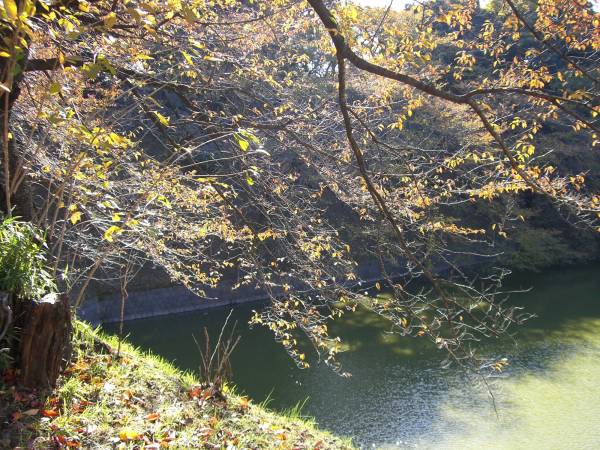
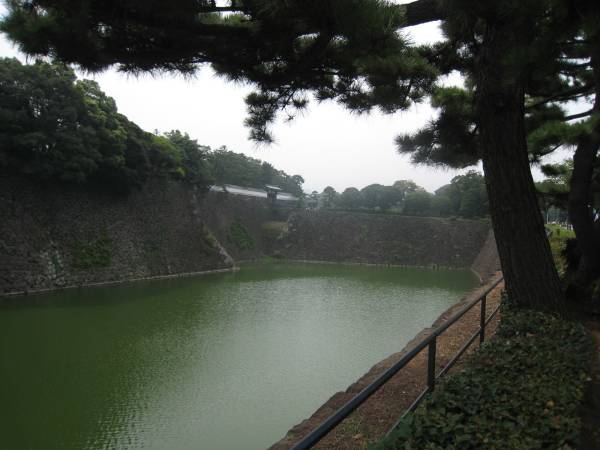
You're on the Chidorigafuchi greenway, a path of about 700 metres along one of the palace moats. Chidori means plover, a small wading bird. Some say the name comes from the shape of the moat, which bends in a V like a bird's wings. Others say it is simply for the many birds that gathered here in winter. This water wasn't dug from scratch. When Edo Castle was expanded, a small river valley was dammed to make a moat. Look at how it curves away from you, following the line of that old valley. Today Chidorigafuchi is one of Tokyo's favourite places for cherry blossom. More than a hundred cherry trees line the path, their branches hanging out over the water, and in blossom season rowing boats drift underneath. Just across the path is a quieter place. The Chidorigafuchi National Cemetery, opened in 1959, holds the remains of Japanese war dead from the Second World War whose names are not known. It serves as a tomb for those who had no family grave to return to.

You're standing outside Hanzōmon, a gate named after a man with a fearsome reputation. Hattori Hanzō served the Tokugawa family, and his house once stood beside this gate. Under the Hattori family's command, men from Iga, a region famous for its ninja, helped guard Edo Castle. More than two hundred of them lived just outside, and until 1943 this area was still called Iga-chō, the Iga quarter. Legend says the gate also had a secret purpose. If Edo ever fell, the shogun could slip out this way and escape west along the road to Kōfu. Nobody can prove it, but it is easy to see why the story stuck. Look across the earth bridge at the gate. It is plain compared with the grand entrances elsewhere, yet today it is one of the most important. Behind it lies the Fukiage Garden, where the Emperor and Empress live, and this is the gate the imperial family uses most. That's why a police box stands guard and the public may not enter. One more trace of Hanzō: the nearby subway line, opened in 1978, carries his name too.

You're at Sakurada-mon, and on a snowy morning in 1860 this gate saw a killing that shook the shogunate. Ii Naosuke was the shogun's chief minister. Two years earlier he had signed a trade treaty with the United States without the Emperor's approval, and then crushed his critics in a purge that hit more than a hundred people. Many samurai were furious. On the morning of 24 March 1860, Ii set out from his residence, only a few hundred metres away, with a procession of about sixty men. Snow was falling. Just outside this gate, eighteen attackers, most of them masterless samurai from Mito, rushed the procession. A shot was fired into his palanquin, and Ii was killed before he reached the castle. The shogunate kept his death secret for about a month. But the damage was done, and eight years later the shoguns were gone. Look at the square between the outer and inner gates, built to trap attackers. Then look across the road. The building opposite is the headquarters of the Tokyo police, which is why Sakuradamon has become a nickname for the police themselves.

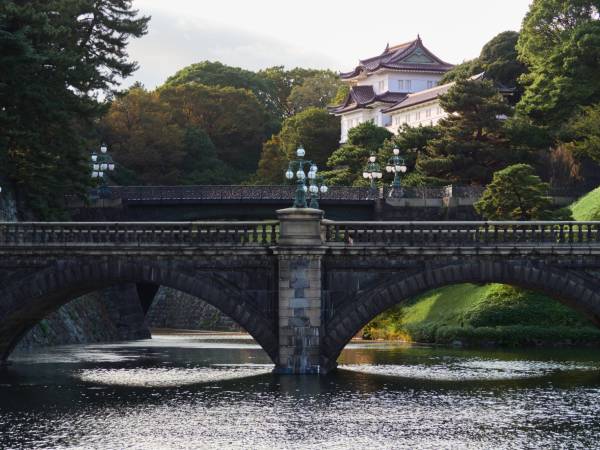
In front of you is one of the most famous views of the palace. But the bridge most people think is Nijūbashi isn't. The stone bridge nearest to you, with its two graceful arches, was built in 1887. Look at how the arches reflect in the water. They make a shape like a pair of glasses, which is why locals call it Meganebashi, the spectacles bridge. The real Nijūbashi is the iron bridge further back. Its name means double bridge, and it comes from the wooden bridge that stood there in the Edo period. The moat was so deep that its supports were built in two layers, one above the other. The wooden bridge is long gone. The first iron bridge was cast in Germany in 1888, and the one you see dates from 1964. Above it, look for the white tower on the wall. This is Fushimi-yagura, said to have been brought here from Fushimi Castle near Kyoto. These bridges stay closed almost all year. Only on 2 January and on the Emperor's birthday do crowds cross them, to see the Emperor greet the public from a palace balcony.

Look across the moat to the white gate on the far side. This is Sakashita-mon, and its name means the gate at the foot of the slope. Today it is a working entrance for the Imperial Household Agency, the office that runs the life of the imperial family, and it is normally closed to the public. In 1862 this gate saw a second attack, just two years after the assassination at Sakurada-mon. The target this time was Andō Nobumasa, one of the shogun's senior councillors. He had worked to bring the shogunate and the imperial court closer together, and had helped arrange the marriage of an imperial princess to the shogun. To some samurai, that was a betrayal. Six men from Mito attacked his procession here. Andō was wounded in the back and ran alone into the castle. All six attackers died. Andō survived, but within a few months he was removed from office. Once again, the shogunate looked weaker than before. One last detail: the gate isn't facing the way it used to. When it was rebuilt in 1887, it was turned ninety degrees from its old direction.

Across the moat in front of you is Kikyō-mon. Kikyō is the Japanese bellflower, and the gate probably takes its name from the bellflower crest of Ōta Dōkan, the warrior whose residence once stood on the hill behind. Look at the round tiles at the ends of the roof, and you may spot that crest. In the Edo period this was one of only two gates where the great lords could enter with their processions. Today it is where visitors gather for tours of the palace grounds. Now look along the wall. On the corner stands Tatsumi-yagura, a two-storey tower named for its position south-east of the castle's centre. It is the last corner tower of Edo Castle still standing. It was damaged in the earthquake of 1923 and rebuilt to look just as it had. Further back, you can make out a taller, three-storey tower. This is Fujimi-yagura, the Mount Fuji viewing tower. After the main keep burned in 1657 and was never rebuilt, this tower became the symbol of the castle. Long ago, on a clear day, you could see Mount Fuji from its windows.

You're standing among the black pines of the Kōkyo Gaien, the palace's great outer garden. There are about two thousand of them, and the planting began in 1888. Here's the surprise. Until 1593 you'd have been standing in the sea. This whole plaza was an inlet of Edo Bay. When the castle was expanded, the inlet was filled in and new land was made. In the Edo period, this new land was lined with the mansions of the shogun's top officials, the senior councillors who ran the government. In the Meiji era the mansions were cleared away, and the open lawns and the pines took their place. In 1949 the garden opened to everyone as a national park. Before the inlet was filled, black pines most likely grew along its shore. So in a way, these trees bring back a coastline that disappeared more than four hundred years ago. Look at the pines around you, low and spreading against the sky. Then look past them to the towers of Marunouchi. An old shoreline, the homes of samurai officials and modern Tokyo, all in one view.

Look up at the samurai on horseback. This is Kusunoki Masashige, a warrior of the fourteenth century, and for a long time he was held up as Japan's great model of loyalty. Kusunoki helped Emperor Go-Daigo overthrow the Kamakura shogunate. The statue shows him bowing his head as he greets the Emperor on his return from exile in 1333. Three years later, Kusunoki was ordered into battle at Minatogawa against a much larger army. He believed the plan would fail, and said so. He went anyway. By the end, only seventy-three of his seven hundred horsemen were left, and he and his brother took their own lives. Legend says their last wish was to be reborn seven times to serve their country. In the late 1800s he was honoured once more, with a shrine and the highest court rank. This statue was a gift from the Sumitomo company, cast from copper from its Besshi mine, and unveiled here in 1900. Several artists worked on it for years, and the head is by the sculptor Takamura Kōun. Look at his face, lowered before the Emperor. It's a portrait of duty, set right in front of the palace.

You're at the spot where Babasaki-mon once stood. Nothing of the gate is left, and the reason is a sad one. The gate was built in 1629 as a heavily defended masugata, a box of walls between two gates. Its name comes from a baba, a horse-riding ground. In 1635 the shogun Iemitsu watched envoys from Korea show off their horsemanship on a riding ground set up here, and the area was named after that show. Almost three hundred years later, in 1904, crowds poured through here to celebrate a victory in the war against Russia. The tight walls of the gate became a trap. People were crushed, and twenty died. Afterwards the walls and the bridge were taken down, and a wide road was built in their place. Look at the road around you, and the moat with its stone walls stretching away to the north. That is all the old castle has left here. That brings us to the end of the walk. Thanks for joining. If you've heard every story, you've circled all of Edo Castle. If not, the other stops are waiting on the map. Either way, the moats still keep the palace apart from the city.