0
Join us on one of the world’s most beautiful boat trips between the idyllic villages of Hellesylt and Geiranger on the legendary Geiranger Fjord. The fjord is one of only two fjords in Norway that are on the UNESCO world heritage list, thanks to its nature that is described as a classic example of the beautiful and very distinctive fjord landscape that is found here in Norway. In addition to the spectacular nature, where mirror bright glaciers and wild waterfalls meet sheltered fjords and mystical mountains, the cultural landscape gives the area an extra dimension with its old farms and stables that literally hang on the steep mountainsides. All of this you can experience directly through the comprehensive narration, pictures and text as the boat approaches or passes the places of interest along the route. We at the Fjords are working to do our utmost to deliver you an excellent travel experience. Enjoy the tour!

Join us on one of the world’s most beautiful boat trips between the idyllic villages of Hellesylt and Geiranger on the legendary Geiranger Fjord. The fjord is one of only two fjords in Norway that are on the UNESCO world heritage list, thanks to its nature that is described as a classic example of the beautiful and very distinctive fjord landscape that is found here in Norway. In addition to the spectacular nature, where mirror bright glaciers and wild waterfalls meet sheltered fjords and mystical mountains, the cultural landscape gives the area an extra dimension with its old farms and stables that literally hang on the steep mountainsides. All of this you can experience directly through the comprehensive narration, pictures and text as the boat approaches or passes the places of interest along the route. We at the Fjords are working to do our utmost to deliver you an excellent travel experience. Enjoy the tour!

Welcome to Geiranger! Now and then words are inadequate, and this is one of those occasions, Geiranger cannot be described it must be experienced! The small fjord village surrounded by steep mountains, dancing river and majestic waterfalls surpasses most Disney Adventures. And we are not alone in that opinion. Few places in the world appear on so many lists of the world’s most beautiful destinations as Geiranger. People have lived here since the stone age, and today the village’s several hundred permanent residents are each year visited by nearly a million tourists over the course of the hectic summer months. Here you can wander through the small fjord centre comprised of boat houses and old wooden houses, enjoy a coffee or ice cream, or try the local chocolate and beer. Take a tour further over the valley along the foaming river to the Norwegian fjord centre and the legendary Hotel Union. And once you get started, you will find a string of cultural-historical, natural experiences just waiting to be found, whether you choose to discover them by boat, car, bus, cycle, or on foot.

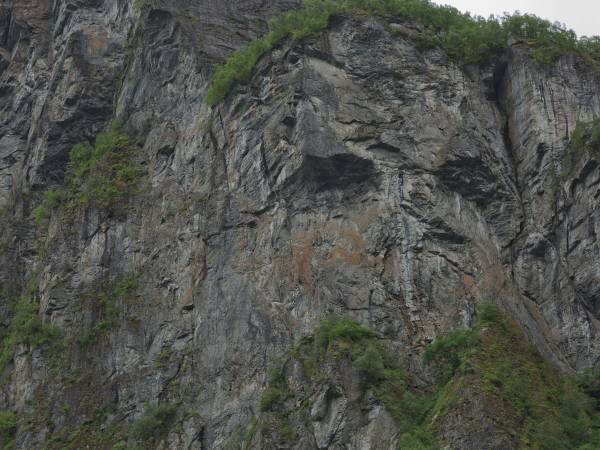
It is not difficult to understand why people are blinded by the magnificent and beautiful nature that they meet here in the fjord. However, something happens when darkness descends or when a thick mist comes down like an impenetrable blanket between the valley sides. Then myths and legends about huldrer, trolls, sea serpents and nisse spring to life. These are the traditional stories of these areas, and many of the tales have their roots in the local communities and continue to be exciting tales for both children and tourists alike. In Valldal, further into the fjord, legend has it that Olav the Holy rowed into these fjords and encountered a huge sea serpent. It was a real struggle, but after a hard battle, Olav defeated the serpent and slammed it into the rock face with such force that the serpent became stuck and the mark that it made remains there today. The precipitous firtree covered mountainsides have throughout the passage of time created strange formations that have fed people’s vivid imaginations. Right where we are passing now, you can see trolls on the rock face even in daylight. Just try! And we daren’t even tell you what you can see at night.

Welcome to Hellesylt which is the gateway to the UNESCO world heritage fjord, Geirangerfjord and the gateway to the spectacular Sunnmøre Alps, from behind which the beautiful Sunnmøre coastline will reveal itself to you. The little village has perhaps undeservedly found itself somewhat in the shadow of Geiranger. But despite that, there are few places in the country that can showcase such spectacular surroundings. Just look at the beautiful waterfall that cascades down right into the centre of the village, and which is often surrounded by stunned tourists taking pictures, in fact it is perhaps one of the most photographed sights in Norway. The lush valleys on the approach to the village are home to the vibrant Sunnmøre farming community, and inspired Henrik Ibsen, when he wrote the world famous, Peer Gynt. Expectant adventurers often use beautiful Hellesylt as their starting point for exciting adventures on the water or in the mountains. Many are drawn to the beautiful Norangsdalen, which is also known as ‘Dronningruta’ (The Queen’s route), presumably because 7 of Europe’s beautiful Queens have taken a trip over it.

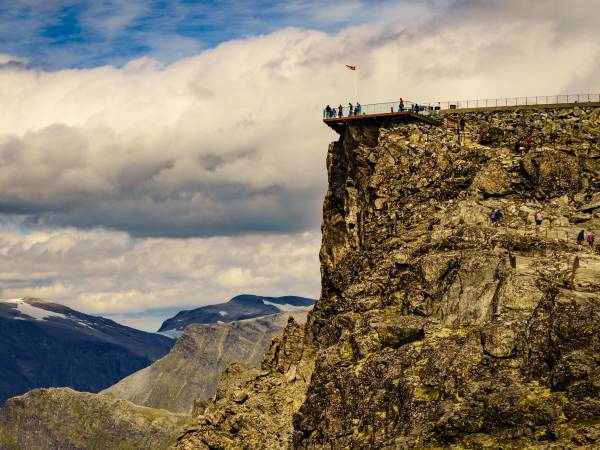
There are few places that can entice with such beautiful untouched nature. And for that reason Geirangerfjord is on the prestigious UNESCO list of world cultural and natural heritage sites. Here, you can also find Norway’s most spectacular viewpoints, regardless of which road you approach the village on. From the centre of the village, you can follow the road up the valley to two of them, Flydalsjuvet and Geiranger Skywalk, Dalsnibba. Flydalsjuvet lies in the middle of the valley and is equipped with glass plates, protrusions, and benches allowing visitors to make the most of the picturesque background of Geirangerfjord, where cruise ships look like small toy boats in the background. From here you can also stare several hundred metres down into the crashing Maråk river as it makes its way down the valley to the centre of Geiranger. Right at the top you will find the magical Geiranger Skywalk at Dalsnibba, 1500 metres above sea level. From there you will enjoy Europe’s highest and most beautiful fjord view. The platform is built out over the mountainside and with a freefall drop of 500 metres you get the feeling that you are floating, even though of course, you are completely safe on the solid platform. All the viewpoints are a part of the National Tourist Route which has the aim of strengthening Norway as a travel destination.

The boat is now passing the point where Geirangerfjord meets Synnulvsfjord. The latter continues further into Storfjorden, which in turn extends all the way to the beautiful Sunnmøre coast and the Jugendbyen of Ålesund. If you look North, you will be able to catch a glimpse of Åkernesremna, which has turned these village communities along the fjords upside down. Because, on the mountainside over Åkerneset there is a large part of the mountain that is in danger of breaking away. A landslide here would, in just a few minutes cause Hellesylt, Geiranger and other small villages along the way to be hit by waves of up to 40 metres high. The local community have learned to live with the danger that is literally hanging over them. Today there is a warning system, that is so good that a landslide would be detected well in advance giving the villagers time to evacuate. However, this was not the case in the well know Norwegian disaster movie ‘the wave’ in which the warning system didn’t work as it should and the subsequent landslide caused monster waves that reached all the way up to the Hotel Union in Geiranger.

Do you see the road dancing up the steep mountainside? That is Ørnevegen (The Eagle’s Wing), today it is stamped as a National Tourist Route, which takes motorists through 11 tight hairpin bends 620 metres over sea level into the small fjord village of Eidsdal. The road was first opened in 1955 and gave Geiranger a much-needed year-round road, it got its name because it passes through an area which is home to lots of eagles. Then as today, the eagles with their enormous wingspans glide majestically high in the air studying the tourists below. From day one, motorists were fascinated by the beautiful view which revealed itself at the top of the road. Soon travellers from the whole of Norway were stopping on the turns to enjoy the spectacular views and before long tourists from Europe and the rest of the world made their entrance on motorbikes, cars, campervans, and busses. The authorities gradually made things more accessible for the tourists, and improved traffic safety by regulating and extending the upper hairpin bend. It has the name the ‘Eagle’s wing’ and is perhaps Norway’s most famous viewpoint. Today, tourists can walk out onto a glass floor, where they can see the world heritage fjord under them whilst at the same time having a panoramic view towards Geiranger and the seven sisters waterfalls. Maybe they can even see the trolls in the rockface on the opposite side of the fjord. Can you?

We are now passing Matvika, (Food Bay) and as the name suggests, this is a particularly fertile spot in the fjord. There were people living here right up until 1961, who subsisted on what the earth provided. The location was particularly favourable for the growing of fruit and large amounts of apples, pears and plums were harvested here. There were even more exotic fruits such as tomatoes and apricots grown here, but it was the goats that provided the main source of income. The farm had hundreds of goats who ran and jumped up the mountainside right up to the summer farm which was a thousand metres up the hillside. There the goats were milked according to traditional methods and the enterprising milkmaids produced both white and brown cheese from the milk. There was little winter fodder down by the fjord, and the resourceful farmers therefore made their very own zip line which was an amazing 1200 metres long for the transportation of hay. To put that into perspective the longest zip line in the Nordics today is in Flåm and is 1381 metres long. The Matvika zip line was reportedly built by as up to as many as 70 men from across the whole area. How many of them took the tour all the way down themselves is not known, but undoubtably it would have been an experience.

Once upon a time, there was a witch who was in love with an imposing man who dumped her in favour of a beautiful maiden from Geiranger. He proposed and soon he, his bride and the whole bridal party were on their way across the fjord to Stranda Church. The witch was very unhappy about this turn of events and when she saw the bridal party set off, she filled a bowl of water in her kitchen. She spun the bowl around and around at the same breathing and cursing feverishly. Out on the fjord the wind increased, and the waves grew and when the witch overturned the bowl, the boats with the wedding party onboard capsized and all were lost both man and mouse. This story can be read about in the local village book, it is claimed that the Parish Priest rowed out into the fjord and painted a white cross on the rock face down by the fjord, where we are now passing. Hence, this place is also known as ‘Korsen’ which means the cross. In Norway there were around 300 people sentenced to death for witchcraft and wizardry, but the witch that this story refers to, was not one of them. In the link below you can read the original judgement from 1614 against Anna Andersdatter from Hellebostad, who received a more lenient punishment.

What do the Suitor, The seven sisters and The devil’s column have in common? They are of course all tourist attractions along the Geiranger fjord. But in addition, they are also three tasty beers in the range of beers produced by the Geiranger brewery. The tourist village has a long tradition of beer brewing. All the farms had their own beer that was brewed for Christmas, often leading to a dispute over who had brewed the best beer. Therefore, a particularly serious competition was arranged at the Hotel Union where impartial people with a good palette for beer judged the beer of the year. The winner was crowned ‘Beer King of Geiranger’ a title up there with other prominent awards. The Geiranger brewery has developed these traditions further and produces exciting new beers that are available in supermarkets, outlets, and restaurants around the country.

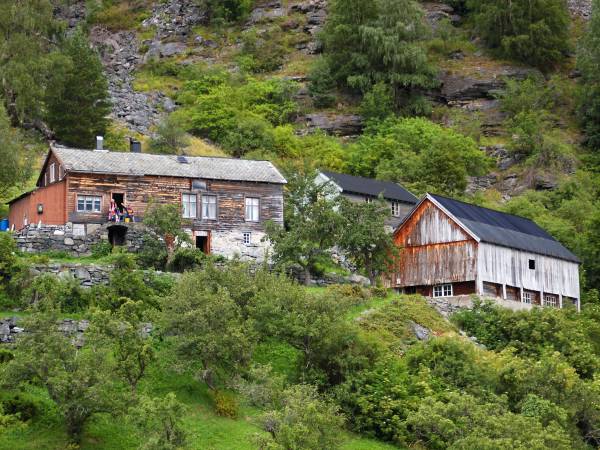
Those who lived in the mountainside farms along the fjord many years ago must have had a head for heights. We are now passing the mountain farm Skageflå which was vacated around 100 years ago. It is idyllically located on a sunny mountain ledge 250 metres up the steep mountainside. Skageflå is one of 10 disused fjord farms on the Geiranger Fjord. Its spectacular position and the exposed and difficult path up, makes the farm the best known of them. As you can appreciate, it was not without danger to either live on or get to the farm. Today, the path that runs to Skageflå is safe. It has been repaired and secured in stages, over the last 150 years. In the past, the hardy fjord folk who lived there had to learn to deal with the dangers that lurked there. The children attended school in Geiranger in stretches of a few weeks at a time, and both learnt and partook in the demanding farm work when they were at home. The smallest children were secured with a rope so that they couldn’t get too close to the dangerous cliff edge. Today the farm is used as a holiday home and a tourist destination, but it is not for those who are afraid of heights.

Perhaps you are wondering why people settled in these impassable places? It sounds a little bit strange, but in Norway there was in fact a lack of space from the 1500s onwards. During that time, Geiranger was so populated that people could not find houses or land. The solution was for people to move to where they could be self-sufficient, often with their closest family. Therefore, we often see settlements along most of the green lungs of the fjord and farms right up the valley sides. The alternative was either to move further inland or out towards the coast. Inland there was not much fishing and along the coast not much of an opportunity for hunting, but here in the fjords there were both. Life along the fjord and up the sides of the valley, of course offered challenges, but also had many high points. Every Christmas the dark fjord was full of rowing boats on their way to Geiranger with lanterns on their sterns. This must have been a beautiful and ceremonious sight. On these farms they lived at one with nature for many generations, but gradually the life became too hard and from the beginning of the 1900s the emigration began. Today, most of the farms are in use as weekend homes or are rented out to tourists.

You will shortly see a gorge that reveals itself in the steep mountainside around 1200 metres up. It is said that it was the devil himself that made it, it therefore goes by the name the devil’s or hell’s column. Legend says that the devil sat on top of the mountain looking at the stars, but he fell asleep and when the sun began to rise, he got up in such a hurry to make it home that he took large parts of the mountainside with him. On the opposite side of the fjord, right down by the fjord edge, you can find the Syltavika Farm, and if you lift your gaze 400 metres above it, you can see the Blomberg Mountain farm. Both these farms, and many more in this fjord, have been restored and taken care of by the voluntary organisation the Friends of Storfjord. Their unique work contributes to preserving the history and in addition creates wonderful experiences for current and future generations.

Have you heard about the suitor who laid his sights on seven wild unmarried sisters, only to have his offers turned down by each and every one of them? Many believe that he became so depressed that he turned to the bottle and sought shelter in the waterfalls on the mountainside that we are now passing, and that is why according to local legend the waterfall has its characteristic bottle shape. On the opposite side of the fjord, you can see one of Norway’s most photographed landmarks, the characteristic ‘Seven Sisters’ waterfalls. From a distance, they look like the hair of seven women, hence the name. The waterfalls are an impressive sight, especially when the snowmelt is big and constantly feeding the waterfalls which on average are in free fall for an incredible 250 metres. And believe it or not, on a small mountain shelf, nearly right at the top of the seven sisters, is the abandoned and landslide prone farm of Knivsflå. It is a very popular tourist destination with its fantastic and spectacular view over Geiranger fjord, where at the same time you can get a feel for its unique history and how it must have been to live there in times gone by.

Are you ready for an adventure? The Norwegian fjords are the perfect base for many activities that get the heart beating faster. You can find something for every taste regardless of physical form, and if you want to get moving the small villages and high peaks offer experiences that you won’t forget. Or maybe the fjord can tempt you with a small paddle tour, or you could whizz over the waves on an inflatable speed boat. Many of the small fjord roads are sheltered, comfortable cycle paths whilst the valley sides are excellent mountain biking terrain. Or perhaps you are tempted to try climbing alongside the Geiranger river, balancing on Nepalese bridges, or flying over gorges and waterfalls. And if that is not for you, there are plenty of other experiences to be had on the water, on land and in the mountains. After such intense experiences it can be good to wind down and get rid of the adrenalin and sweat, and what could be better than a little dip in the fjord before relaxing at one of the areas wonderfully varied overnight accommodation options. The possibilities are endless. Check out the link for some of the experiences on offer.

For around two weeks every year, a very special phenomenon occurs right where we are passing now. Melt water from the high Sunnmøre Mountains reaches its climax here when the water rushes down the mountain and creates what is known as the bridal veil. The waterfall of the same name then produces a beautiful fine spray, which together with the wind fans the water across the mountain road like a beautiful transparent bridal veil. If the sun is shining it creates an incredibly beautiful rainbow effect, which gets the tourists’ cameras clicking. There are seven other places in Norway that have waterfalls called the Bridal Veil, but this is the most famous and is ranked amongst the 50 biggest waterfalls in Norway. Directly above and next to the famous waterfall the mountain farms Megardsplassen and Horvadrag hang on two narrow ledges almost 500 metres above sea level. The last tenants left the farm in 1900, but considered moving back the year after, but by then an avalanche had taken all the houses and washed them into the fjord. Had they still been living there; they too would have followed their house down to the bottom of the fjord.

Queen Sonja of Norway has for many years been the patron of the organisation the Norwegian Trekking Association. She is known as the trekking Queen and there is hardly a mountain top in Norway that she hasn’t visited. Indeed, the Geiranger fjord, villages, and mountains around are amongst the Queen and her family’s most visited destinations. In 1993 the King and Queen even celebrated their silver wedding anniversary here in Geiranger fjord, at the mountain farm Skagaflå, with royal guests from around the whole world. The guests, including 7 Queens, also took a trip through the beautiful Norangsdalen, which is now known by the nickname the ‘Queens’ route’. The Queen who is an art and outdoor enthusiast unveiled the design installation «Fjordsetet» in 2003 on one of her trips to Geiranger. In Oslo a sculpture of the Queen entitled “The Trekking Queen” was unveiled in 2017.

Join us on one of the world’s most beautiful boat trips between the idyllic villages of Hellesylt and Geiranger on the legendary Geiranger Fjord. The fjord is one of only two fjords in Norway that are on the UNESCO world heritage list, thanks to its nature that is described as a classic example of the beautiful and very distinctive fjord landscape that is found here in Norway. In addition to the spectacular nature, where mirror bright glaciers and wild waterfalls meet sheltered fjords and mystical mountains, the cultural landscape gives the area an extra dimension with its old farms and stables that literally hang on the steep mountainsides. All of this you can experience directly through the comprehensive narration, pictures and text as the boat approaches or passes the places of interest along the route. We at the Fjords are working to do our utmost to deliver you an excellent travel experience. Enjoy the tour!