0
Welcome aboard Trondheim by Boat! We are very happy to have you with us today. Trondheim is a city with more than a thousand years of history, and one of the best ways to experience it is from the water. Today, we will take you on a journey through Trondheim’s unique mix of history, coastal culture and modern city life. Trondheim was founded by Olav Tryggvason in the year 997 and was Norway’s capital for 200 years. Through Nidaros Cathedral and the archbishopric, the city became an important religious and political centre, as well as a major destination for pilgrims. The Nidelva River has been the city’s lifeline and trade route since before the Viking Age. Trondheim and the surrounding region also have deep connections to Sámi history and culture. After more than 400 major city fires, especially the great fire of 1681, Trondheim was rebuilt with wide streets based on Cicignon’s city plan. Over time, the city developed from an important trading centre with wharves along the Nidelva into a leading university and technology city, combining historic heritage with forward-looking innovation. As we sail out, we will pass some of the city’s most iconic sights. We will see the colourful wharves along the Nidelva, a reminder of Trondheim’s history as one of Norway’s most important trading cities. We will also pass Nidaros Cathedral, Norway’s national sanctuary, and Gamle Bybro, often called the “Gate of Happiness”, which has connected the city since 1681. We are proud to be your skippers and guides today. Our goal is to give you an authentic experience filled with sea air, history and a good atmosphere. Sit back, breathe in the fresh sea air and enjoy the trip. If you have any questions along the way, please feel free to ask us. Welcome aboard!

Welcome aboard Trondheim by Boat! It is a pleasure to have you with us today. Trondheim is a city with over a thousand years of history, and the very best way to experience the city is from the water. Today we will take you on a journey that shows Trondheim's unique mix of history, coastal culture and modern city life. Trondheim was founded by Olav Tryggvason in the year 997 and was the capital of Norway for 200 years. The city was the country's religious and political center through the Nidaros Cathedral and the archbishopric, and an important pilgrimage destination. The Nidelva has been the city's lifeblood and trade artery since before the Viking Age, and Trondheim and the region also have deep ties to Sami history and culture. After over 400 major city fires, especially in 1681, the city was rebuilt with wide streets inspired by Cicignon's plan. From being an important trading city with docks along the Nidelva River, Trondheim has developed into a leading technology and university city in modern times, combining historical heritage with forward-looking innovation. As we sail out, we will pass several of the city's most iconic sights. We will see the colorful docks along the Nidelva River - a reminder of Trondheim's time as Norway's most important trading city. We will pass Nidaros Cathedral, our national shrine, and Gamle Bybro - often called the 'Gate of Happiness' - which has connected the city since 1681. We are proud to be your skippers and guides today, and our desire is to give you an authentic experience characterized by the joy of the sea, history and good atmosphere. Sit back, breathe in the fresh sea air, and enjoy the trip. If you have any questions along the way, just let us know. Welcome aboard!

Brattøra is an area that has changed dramatically over time. Originally, this was not a modern city district at all, but a low-lying area of sandbanks, shallow water, and river deposits at the mouth of the Nidelva River. For a long time, parts of Brattøra were either under water or shaped by mudflats, sandbanks, and harbour activity. Gradually, through land uplift, filling, and dredging, the area became a larger and more important part of the city. In earlier times, Brattøra also had a strong symbolic role. This was the site of Øretinget, an ancient assembly where important decisions were made. The thing, or assembly, was a central institution in old Norwegian Viking society, both legally and politically. The area was also used as a place of execution, so Brattøra was connected to power, law, and punishment. At the end of the 19th century, Brattøra was completely transformed. City engineer Carl Adolf Dahl was behind major plans for a modern harbour and railway. Between 1878 and 1887, the seabed was dredged, and the area was prepared for new harbour facilities and a railway station. Today, Brattøra is a hub for transport, culture, and city life. Here you will find Rockheim, Norway’s national museum of popular music, and Pirbadet, one of the country’s largest indoor swimming facilities. In many ways, Brattøra tells the story of Trondheim in miniature: a city that has always lived with the sea – and has always kept rebuilding itself.

Ravnkloa is one of the best-known places in Trondheim, and for many people, this is where the city truly meets the fjord. This open public space lies at the lower end of Munkegata, on the historic axis between Nidaros Cathedral and Munkholmen. That location says a lot. For hundreds of years, this is where the city turned towards the sea, the fish, and the trade that came with it. The name Ravnkloa has been in use since the early 18th century. It may be linked to a man named Peder Raffnklau, who is mentioned in written sources as early as 1619. Ravnkloa has long been an important place for fish trading. From 1841, it was also used as a market area, and in 1896 a dedicated fish market was established here. In 1945, the fish trade moved indoors into a temporary fish hall, and the current fish market building opened in the year 2000. The fish trade here was not just a romantic piece of coastal heritage. It was part of the city’s daily economy and everyday life. People came here to buy food, meet each other, and see what the sea had provided. So Ravnkloa is more than just a pleasant place by the water. It is a living reminder of Trondheim as a trading city, a seafood city, and a coastal city.

Fosenkaia is one of those places where Trondheim’s maritime history still feels close and alive. This is where the local coastal heritage association, Kystlaget, is based. They work to preserve coastal culture, traditional boat types, and the craftsmanship that belongs to them. This is not just about old boats as museum objects. It is about living knowledge: how boats are built, maintained, sailed, and used. Along the quay, you can often see older wooden boats. Many of them represent a time when the sea was the main road between people. Before modern roads and cars, boats were essential for fishing, trade, transport, and contact between farms, villages, and towns. Trondheim has always been closely connected to the fjord. Goods, people, food, and news all arrived by sea. That is why Fosenkaia is more than a pleasant quay with boats. It is a small reminder of how the city actually functioned. Here, old and new also meet. Traditional boats lie side by side with modern city life, and the area shows how coastal culture can still be an active part of Trondheim today. Fosenkaia reminds us that Trondheim is not just a city by the sea. Trondheim is a city shaped by the sea.

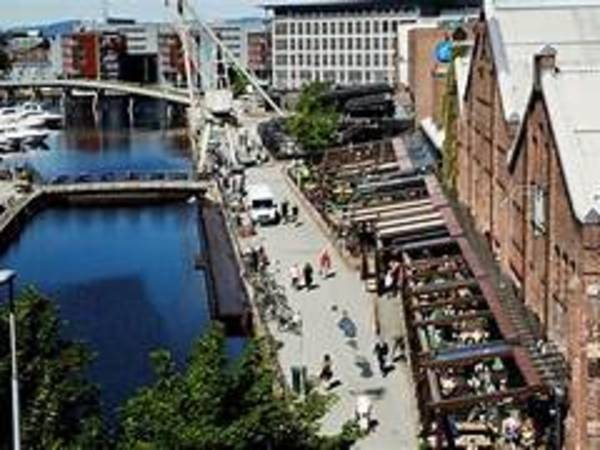
Today, Solsiden is known for restaurants, shops, and lively city life. But before it became one of Trondheim’s most popular urban areas, this was a busy industrial district. This was the home of Trondhjems Mekaniske Værksted, often called TMV. The shipyard was founded in 1862 and moved here to Rosenborgfjæra in 1886. That move marked the beginning of a golden age for the area. TMV built and repaired ships and developed into one of Norway’s leading shipyards. Well-known vessels such as DS Erling Jarl, DS Haakon VII, MS Harald Jarl, and MS Narvik were built here. These were ships that helped connect the Norwegian coast, and they made the shipyard an important part of Norwegian maritime history. During the Second World War, the German occupation authorities took control of operations. After the war, the yard continued for several decades, but in 1983 TMV was closed down. Today, the area has been transformed into Nedre Elvehavn and Solsiden. Many of the old buildings and docks have been preserved, giving the area its very particular atmosphere. Here, industrial history meets modern city life. That is quite typical of Trondheim: the city builds on its history, rather than erasing it completely.

The canal is an important part of Trondheim’s old harbour. Today, it may look like a natural part of the cityscape, but this area has been shaped by nature, trade, and urban planning. Parts of the area were once fjord and shallow harbour water, while the city itself lay further in, closer to the Nidelva River. As Trondheim grew, the harbour had to be expanded and adapted to new needs. A major turning point came after the great city fire of 1681. Trondheim was then rebuilt according to a new city plan, designed by General Johan Caspar de Cicignon. The plan gave the city wider streets, straighter axes, and more space between buildings. This was not only about appearance. It was also about fire safety. Trondheim was a wooden city, and fire could spread quickly. Much of the city centre, Midtbyen, still follows this plan today. When you see the broad streets and the clear structure, you are really seeing the traces of a disaster – but also an attempt to build a safer and more modern city. The canal therefore tells several stories at once. It is about harbour life and shipping, but also about fire, rebuilding, and Trondheim’s ability to adapt.

The Old Town Bridge is one of the most iconic places in Trondheim – and a natural stop for both photos and reflection. The bridge is often called “The Portal of Happiness”. The name comes from the song Nidelven stille og vakker du er, and it is easy to understand why. From here, you can see the river, the wharves, Bakklandet, and the city’s old wooden houses all at once. The first bridge on this site was built after the city fire of 1681, as part of Cicignon’s new city plan. It was meant to connect the city centre with Bakklandet, but it also had a military function. It formed a strategic link to Kristiansten Fortress on the hill above the city. The bridge you see today dates from 1861 and was designed by city engineer Carl Adolf Dahl. Its red portals have become a symbol of Trondheim, marking the transition between two quite different parts of the city. When you cross the Old Town Bridge, you are not just moving from one side of the river to the other. You are leaving the busier city centre and entering the calmer streets of Bakklandet. That may be why the bridge feels a little special. It is not just a way across the water – it is a small journey in itself.

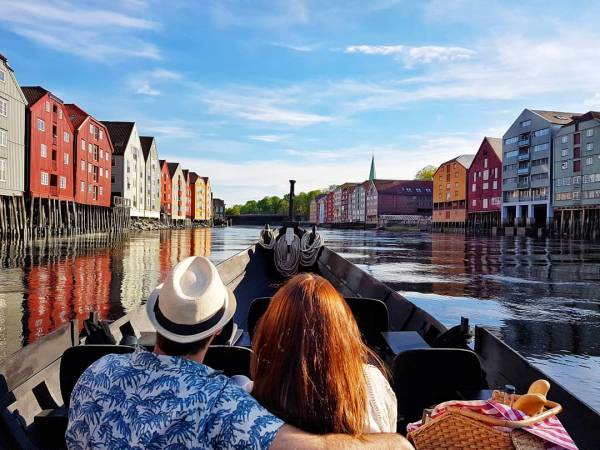
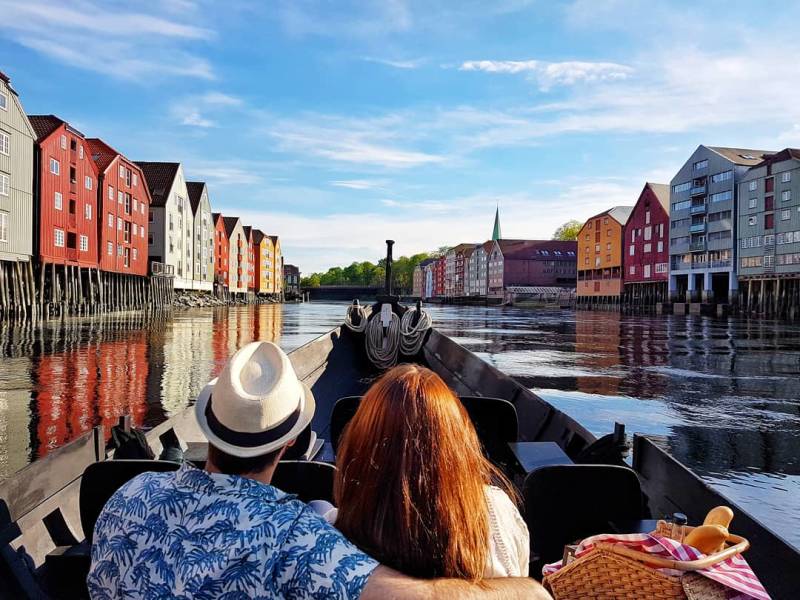
The wharves along the Nidelva River are among Trondheim’s most famous views. But they are far more than beautiful façades. This was the city’s old trading centre. The wharves were storage buildings, placed right down by the water so goods could be loaded directly on and off boats. Grain, fish, timber, and other goods moved in and out here, connecting Trondheim to the surrounding region – and to the wider world. The oldest wharves still standing today date from the 18th century. Many are built of timber, often using traditional log construction, with their gables facing the river. Notice the hoisting mechanisms near the top of the buildings. They remind us of a time when goods were lifted straight from the boats and into storage. Kjøpmannsgata received its name in the city plan after the fire of 1681. The street was laid out as a wide firebreak between the city and the wharves. The planted central strip was also meant to catch sparks if a fire broke out. That was necessary. Trondheim was a wooden city, and many wharves have burned throughout history. Today, the wharves are strictly protected. They tell the story of Trondheim as a trading city, a seafaring city, and a wooden city – all at once.

Bakklandet is Trondheim’s oldest suburb, and one of the city’s most atmospheric neighbourhoods. The area began to grow in the mid-17th century, on the eastern side of the Nidelva River. Because Bakklandet lay outside the old city boundary, it was not included in Cicignon’s strict city plan after the fire of 1681. That is why the streets here still feel more organic. They follow the terrain, giving us perhaps a small impression of what Trondheim may have looked like before the great re-planning of the city. Bakklandet has had a dramatic history. It was burned by Swedish forces in 1658, and again in 1718 – this time by Norwegian forces, as a defensive measure to prevent the enemy from using the area. Along the river there were wharves, workshops, and simple homes. Craftsmen, workers, and small traders lived here, close to both their workplaces and the waterway. Bakklandet was also an important industrial area. There was a brickworks here already in the Middle Ages, and later came shipyards, boat repair, and mechanical industry. In the 19th century, steamships were built here – and so was Norway’s first Norwegian-built locomotive, Thrønderen. Today, many people know Bakklandet for its wooden houses, cafés, and peaceful atmosphere. But beneath the charm lies a history of work, industry, fire, and survival.

Today, Marinen is one of Trondheim’s most popular green spaces. In the summer, people sit on the grass with the Nidelva River on one side and Nidaros Cathedral just behind them. But the area has a much more military background. Marinen was originally part of the city’s defences along the river. Together with bastions, earthworks, and palisades, the area was meant to protect Trondheim from attacks from the water. Its location was strategic: right between the river and some of the city’s most important centres of power, such as Nidaros Cathedral and the Archbishop’s Palace. In the early 19th century, the area took on a new function. After the British attacks on Copenhagen in 1801 and 1807, it became clear how vulnerable Nordic cities could be from the sea. Marinen was therefore used as a storage and maintenance area, and as a small shipyard for naval vessels such as gunboats. Earlier, many buildings stood along the riverbank, stretching down towards Elgeseter. Most of them are gone today, either demolished or lost to fire. Today, Marinen is an open urban space for recreation. An area that has moved from defence and military readiness – to picnics, concerts, and everyday city life.

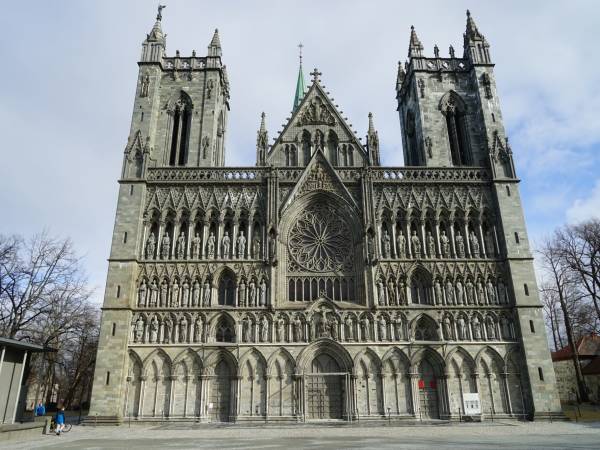
Nidaros Cathedral is Norway’s national sanctuary and one of the most important church buildings in the Nordic region. The cathedral is built over the final resting place of Olav Haraldsson, who fell at the Battle of Stiklestad in 1030. The following year, he was declared a saint, and his grave quickly became an important pilgrimage destination. In the Middle Ages, pilgrims came here from large parts of Northern Europe. Construction began around 1070. The earliest parts were built in Romanesque style, influenced by Anglo-Norman architecture. Later, especially after the time of Archbishop Øystein, the cathedral was expanded in Gothic style, inspired by English cathedrals. In the Middle Ages, Nidaros Cathedral was the archbishop’s church and the centre of the Catholic Church in Norway. After the Reformation in 1537, it became a Lutheran cathedral. The church has been damaged by several fires. After the fire of 1531, the nave stood for a long time as a roofless ruin. Restoration began in 1869 and became one of the largest building projects in Norwegian history. Nidaros Cathedral has also been used for royal coronations and, in more recent times, for the blessing ceremonies of Norwegian monarchs. In the Middle Ages, the cathedral was called Cor Norvegiae – the Heart of Norway. For many, it still is.

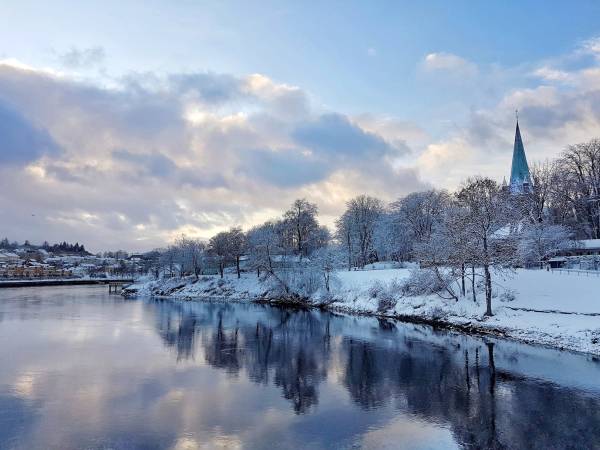
The Nidelva River is the lifeline running through Trondheim. The name is old, and its meaning is not entirely certain. It may be connected to words meaning to flow or stream, or to descriptions of the river as shining or rushing. In Southern Sámi, the river is called Nïejtejohke. Nidelva is the lower part of the Nea-Nidelva watercourse. It flows from Lake Selbusjøen and continues north before meeting the Trondheim Fjord at Brattøra. Along the way, it winds through landscapes, residential areas, and finally the historic city centre. People have lived along the river since the Stone Age. Later, the river became essential for trade, crafts, transport, and the development of the city. The old wharves along the river show how important this waterway was for loading, unloading, and storing goods. Nidelva is also known as a salmon river. The lower stretch, up to Nedre Leirfoss, is accessible to salmon, and the river has been home to a large and powerful salmon stock. Today, the river is used for fishing, paddling, boating, and recreation. It is nature, city space, and historic transport all at once. And for many Norwegians, it is perhaps best known through Oskar Hoddø’s waltz: You quiet and beautiful Nidelven.

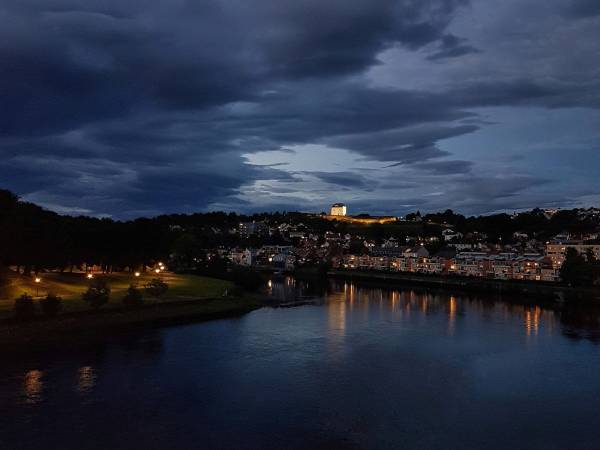
Kristiansten Fortress stands on the hill above Trondheim, with views over the city, the fjord, and Bymarka. The fortress was built after the great city fire of 1681. The fire showed how vulnerable the city was, and the new city plan was not only about streets and buildings – it was also about defence. Kristiansten was constructed between 1682 and 1684, by order of King Christian V. Johan Caspar de Cicignon and Anthony Coucheron were central to the planning. Its location was strategic. From the hill, the approach from the east could be controlled, and the city could be protected from attack. The fortress faced its most important test during the Great Northern War in 1718, when Swedish forces under General Armfeldt attempted to take Trondheim. The fortress helped prevent the city from being captured. Later, Kristiansten lost much of its military importance, but the area continued to be used. Among other things, it served as a fire lookout, because of the excellent view over the city. During the Second World War, the fortress was used as an execution site by the occupying forces – a dark chapter in its history. Today, Kristiansten is a protected museum area and one of Trondheim’s best viewpoints. From here, you can clearly see how the city lies between the river, fjord, and landscape.