St Andrew Square & George Street
0
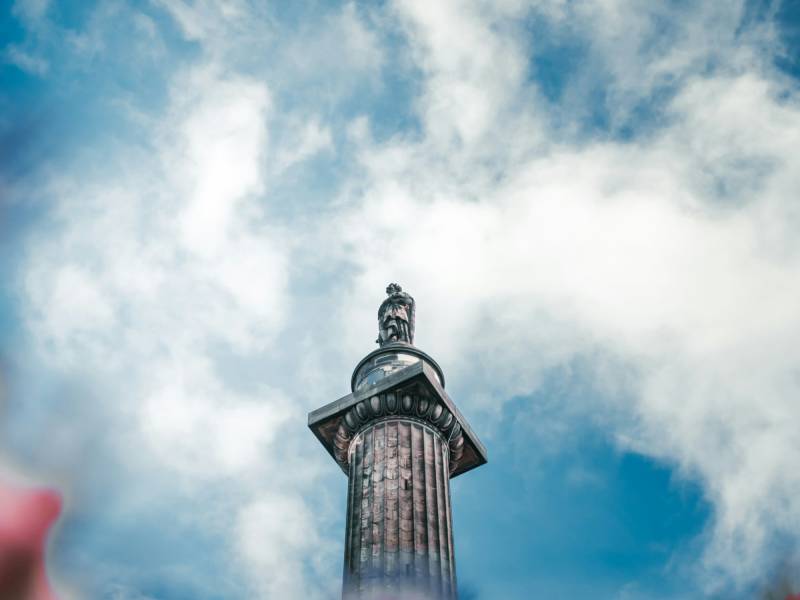
You've crossed Princes Street into a different Edinburgh altogether. Behind you, the Old Town grew where it liked — upwards, inwards, on top of itself — for six hundred years. This did not. Three straight streets running between two garden squares, drawn in one go, on paper, in 1766, by a twenty-six-year-old architect nobody had heard of called James Craig. He won the competition, the city built his plan, and what you're standing in is the largest surviving Georgian townscape in the world. George Street is the spine and this is its eastern square. Craig meant a church to stand here. He was overruled: Sir Lawrence Dundas already owned the ground and in 1774 put his own mansion on it instead, squarely on the plot meant for God. It has been the head office of the Royal Bank of Scotland since 1825, and if the doors are open, look in at the banking hall — a deep blue dome pierced by five tiers of gold-rimmed stars. The column in the gardens is the Melville Monument: forty-five metres of Trajan's Column raised in the 1820s to Henry Dundas, the man who effectively ran Scotland for a generation. It went up with a balance crane borrowed from the Bell Rock Lighthouse, designed by the engineer Robert Stevenson — grandfather of the novelist we met on the Royal Mile earlier today. A plaque added in 2021 records the harder half of the story: Dundas's part in delaying the abolition of the Atlantic slave trade. The city is still arguing about him, and the argument belongs here as much as the column does. George Street runs due west from here, and our last stop sits at the far end — about twelve minutes in a straight line. Glance down the side streets as you go: those glimpses of water to the north are no accident, they were drawn in.