0
Edinburgh is built on a volcano, and the city has never quite got over the drama of it. From the castle on the rock, the Royal Mile falls away towards Holyrood, past narrow closes and streets buried beneath the ones you're walking on. Across the valley the New Town lies in straight Georgian lines, as if the city changed its mind. This walk takes you through both – and up Arthur's Seat, where you can see why each one sits where it does.

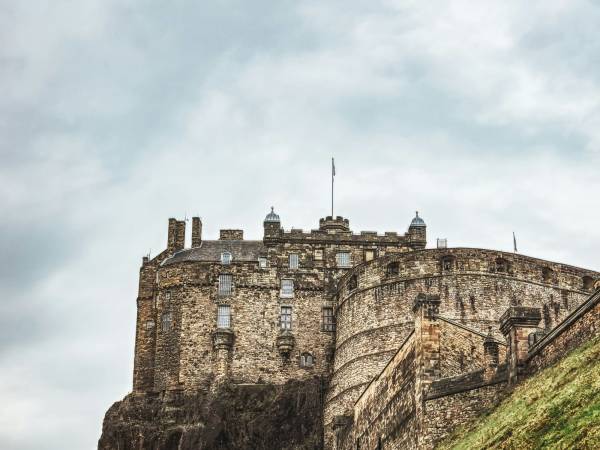
Welcome to Edinburgh — and there's no better place to begin than here, on the Castle Esplanade. The fortress above you sits on Castle Rock, the plug of an extinct volcano that last erupted some 350 million years ago. People have lived on this rock since the Iron Age, and the castle itself has been fought over more than almost any other place in Britain — besieged 26 times in its long history. Inside its walls you'll find the Scottish Crown Jewels, the Stone of Destiny on which Scottish kings were crowned, and St Margaret's Chapel, the oldest surviving building in Edinburgh, dating from around 1130. Every day except Sunday, listen for the One O'Clock Gun — a tradition from 1861 that once helped ships in the Firth of Forth set their clocks. And if you're here in August, this esplanade transforms into the grandstand of the world-famous Royal Edinburgh Military Tattoo. Take a moment to enjoy the view before we head down the Royal Mile — the historic spine of the Old Town, stretching exactly one Scots mile from the castle gates to a royal palace.

You're now standing at the very top of the Royal Mile, on Castlehill. The tall tower beside you houses the Camera Obscura and World of Illusions — Edinburgh's oldest purpose-built visitor attraction, welcoming curious guests since 1853. At its heart is a Victorian “camera obscura”: a periscope-like device of lenses and mirrors that projects a live, moving image of the city onto a viewing table in a darkened room. In the 1850s, this was pure magic — a drone's-eye view of Edinburgh a century and a half before drones existed. Castlehill also has a darker past: between the 15th and 18th centuries, hundreds of people, mostly women, were executed here after being accused of witchcraft. The small Witches' Well fountain near the esplanade quietly commemorates them. A few steps further down the street, in a former Victorian schoolhouse, stands The Scotch Whisky Experience — and you can't come to Scotland without talking about whisky, in Gaelic uisge beatha, “the water of life.” This is the perfect crash course. Inside, a barrel ride takes you through the production process, and you can admire the world's largest collection of Scotch whisky — nearly 3,400 bottles gathered by a Brazilian collector, Claive Vidiz. Scotland has five main whisky regions, each with its own character: light and floral Lowland drams, honeyed Highland malts, fruity Speysides, and the famously smoky, peaty whiskies of Islay. For a whisky to legally be called Scotch, it must be matured in oak casks in Scotland for at least three years. Whether you stop in for a tasting or simply carry the thought with you, remember the Scottish toast: Slàinte mhath — good health! And as you walk on down the Royal Mile, notice how the buildings grow taller — Old Town Edinburgh built upwards, not outwards, creating some of the world's first high-rise living.

This six-storey building with its distinctive arched frontage is Gladstone's Land, one of the oldest surviving tenements on the Royal Mile, dating back to the early 1600s. It's named after Thomas Gledstanes, a wealthy merchant who bought it in 1617 and extended it towards the street to maximise valuable frontage. Step back and look up: in the 17th century, a building like this was a vertical cross-section of Edinburgh society. Wealthy merchants occupied the comfortable middle floors, tradesmen and shopkeepers worked at street level, and the poorest crammed into the cellars and attics. With the city walls preventing outward growth, tenements here reached ten storeys or more — remarkable skyscrapers of their day. Inside, the National Trust for Scotland has restored painted Renaissance ceilings and period rooms that let you smell, almost taste, life in the crowded Old Town, when this single street held tens of thousands of people. Walk on a few steps east and look for a narrow opening on your left: Lady Stair's Close. Tucked down there is an ornate 17th-century townhouse — the Writers' Museum, celebrating three giants of Scottish literature: Robert Burns, Sir Walter Scott, and Robert Louis Stevenson. Burns, Scotland's national poet, gave the world “Auld Lang Syne” — sung every New Year's Eve across the globe. Scott practically invented the historical novel and almost single-handedly rebranded Scotland's romantic image in the 19th century. And Stevenson, born here in Edinburgh, wrote Treasure Island and The Strange Case of Dr Jekyll and Mr Hyde — a tale said to be inspired by his home city's split personality: the respectable New Town and the shadowy Old Town. In the courtyard, look down: quotations from Scottish writers are carved into the paving stones of Makars' Court — “makar” being the old Scots word for poet. Edinburgh takes its words seriously; in 2004 it became UNESCO's very first City of Literature. Back on the Royal Mile, carry on downhill; the crowned spire ahead of you is our next stop.

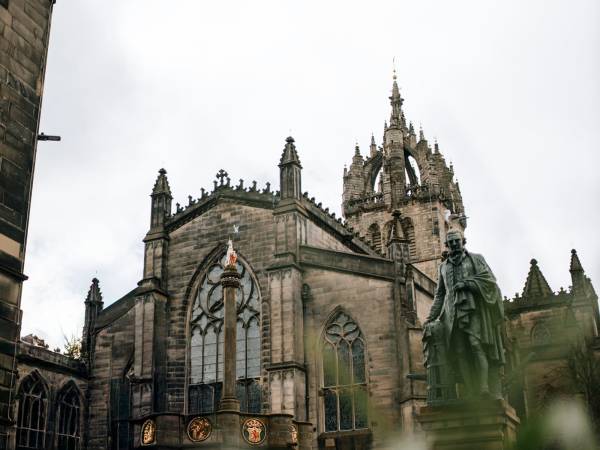
The crowned spire above you belongs to St Giles' Cathedral, the High Kirk of Edinburgh, watching over the Royal Mile for around 900 years. Its distinctive crown steeple, completed around 1495, is one of the city's most beloved silhouettes. This was the pulpit of John Knox, the fiery preacher who led the Scottish Reformation in the 1560s and transformed Scotland into a Protestant nation. Inside, don't miss the Thistle Chapel — a small early-20th-century masterpiece of carved stone and wood, home to the Order of the Thistle, Scotland's highest order of chivalry. Look closely at the carvings and you'll even find an angel playing bagpipes. Just outside, set into the cobblestones, is the Heart of Midlothian mosaic marking the site of the old Tolbooth prison. You may see locals spit on it as they pass — an old gesture of contempt for the prison, and today, they say, a bit of good luck. When you're done here, carry on a few steps down the Royal Mile. On your left, beneath the large pillared building, is the entrance to our next stop.

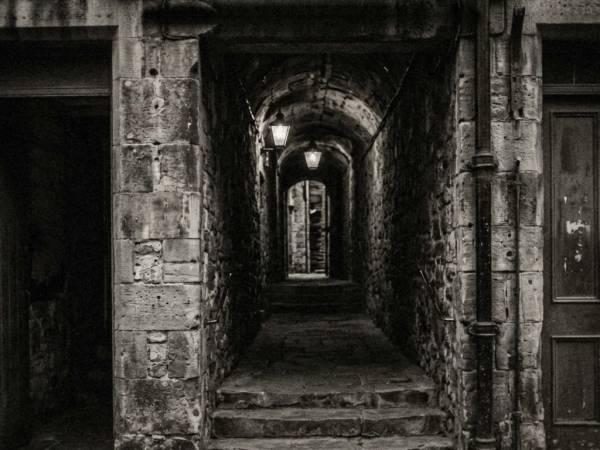
Beneath the Royal Exchange building lies one of Edinburgh's most atmospheric secrets: Mary King's Close, a warren of 17th-century streets frozen in time beneath the modern city. A "close" is a narrow alleyway between tenements, and this one was named after Mary King, a merchant burgess who traded here in the 1630s — a notable achievement for a woman of her era. When the Royal Exchange was built in the 1750s, the tops of the old tenements were sheared off and the lower floors used as foundations, sealing the streets below. The close endured Edinburgh's devastating plague outbreak of 1645, and legends of hauntings have swirled ever since — most famously the ghost of a little girl called Annie, for whom visitors still leave toys. Today guided tours take you down into the preserved rooms and passageways, where you can walk streets unchanged for over 350 years, hidden just metres beneath your feet. Carry on down the Royal Mile from here — a couple of minutes and you'll reach the junction where South Bridge and North Bridge meet the street, and that's where we stop next.

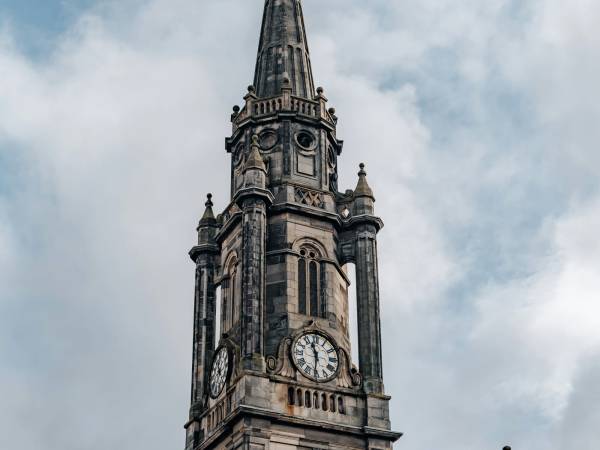
The church with the elegant spire ahead is the Tron Kirk, built in the 1630s and named after the "tron," the public weighing beam that once stood nearby — where dishonest merchants were sometimes nailed by the ear as punishment. For generations, locals gathered here to celebrate Hogmanay, the Scottish New Year. Now look at the junction: South Bridge crosses the valley to your right, and here's the surprise — it's a bridge of 19 arches, but you can only see one. The rest are buried beneath the buildings that line it. Inside those hidden arches lie the South Bridge Vaults, chambers that housed workshops, taverns and, later, some of the city's poorest residents in damp, lightless conditions. The vaults were rediscovered in the 1980s and are now among Edinburgh's most popular ghost-tour destinations. This city, you'll notice, has a habit of building on top of itself — layer upon layer of history, quite literally underfoot. Cross the junction and keep heading east down the Royal Mile. A couple of minutes on, look to your left for a narrow house with jettied upper floors overhanging the pavement — that's our next stop.

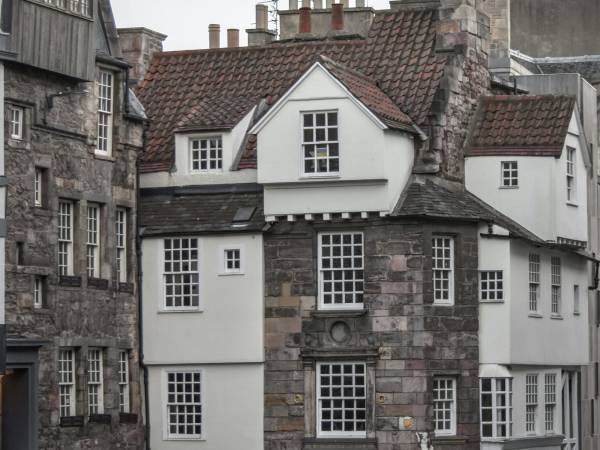
Two contrasting treasures face each other on this stretch of the Royal Mile. The Museum of Childhood, opened in 1955, claims to be the first museum in the world dedicated to the history of childhood — a delightfully nostalgic collection of toys, dolls, train sets and games spanning generations. Ironically, its founder, town councillor Patrick Murray, cheerfully insisted he didn't particularly like children. Across the street stands John Knox House, jutting out into the pavement with its timber gallery and hand-painted decoration — one of the oldest surviving houses in Edinburgh, dating from around 1470. Whether the Reformation preacher John Knox actually lived here is debated, but the association helped save the building from demolition in the 19th century. It genuinely was home to James Mossman, goldsmith and keeper of the royal mint to Mary, Queen of Scots — a loyalty that cost him his life when the Queen's cause fell. Keep going downhill. Just below the house you'll pass the World's End, the junction where the old city gate once stood — from here down, the Royal Mile becomes the Canongate. Follow it for about five minutes until you see a church with a curved gable on your left.

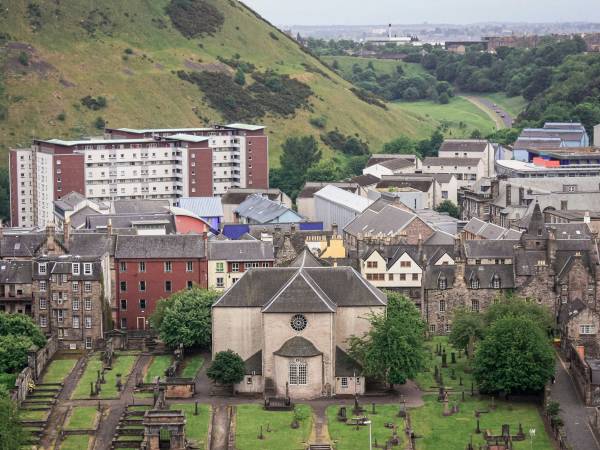
You've now crossed into the Canongate, once a separate town that grew up around Holyrood Abbey — its name comes from the canons, the clergy, who walked this "gait," or way. Canongate Kirk, with its curved Dutch-style gable and royal coat of arms, was completed in 1691 and remains the parish church of both Edinburgh Castle and the Palace of Holyroodhouse; royalty attend services here when in residence. In 2011, Queen Elizabeth II's granddaughter Zara Phillips married rugby player Mike Tindall in this modest kirk. The churchyard is one of the city's most storied: here lies Adam Smith, father of modern economics; the poet Robert Fergusson, whose statue strides along the pavement outside — Robert Burns admired him so much that he paid for his headstone; and, according to persistent legend, David Riccio, the murdered secretary of Mary, Queen of Scots. Pause among the stones; few churchyards pack in this much history per square metre. When you're ready, carry on down the Canongate. A couple of minutes further the street opens up, and on your right stands a building that looks like nothing else in this city.

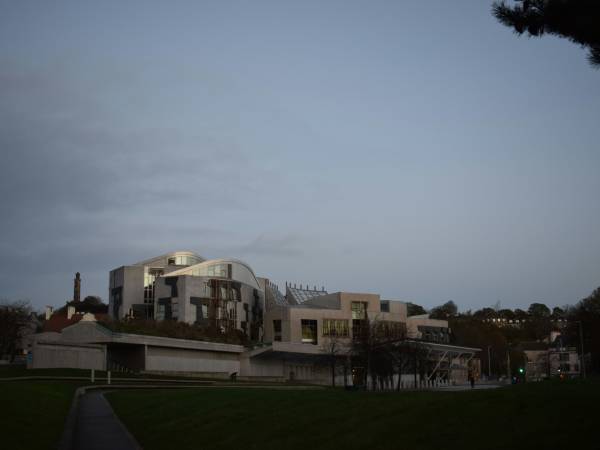
At the foot of the Royal Mile stands one of Britain's most debated modern buildings: the Scottish Parliament, opened in 2004. Designed by Catalan architect Enric Miralles, who sadly died before its completion, the complex is meant to grow out of the land itself — its shapes inspired by upturned boats, leaves, and Charles Rennie Mackintosh's flower paintings. The project famously cost around ten times its original estimate, arriving three years late at over £400 million, and locals argued fiercely over its merits. Yet it went on to win the Stirling Prize, the UK's highest architectural honour. More importantly, it represents something historic: after the Act of Union in 1707 dissolved Scotland's old parliament, the country waited 292 years for its own legislature to reconvene. When the devolved parliament first met in 1999, it marked a new chapter in Scottish self-governance. Visitors are welcome inside — the debating chamber, with its sweeping timber roof, is worth a look. From here it's just a few minutes further east, down to the foot of the Royal Mile. There stands the palace that has closed off the end of this street for more than four hundred years.

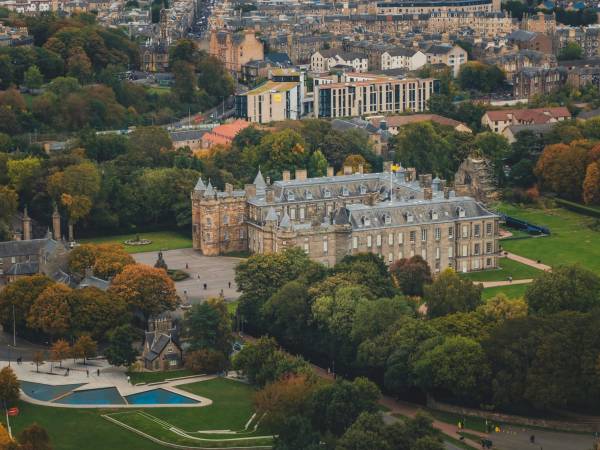
Facing the Parliament stands the Palace of Holyroodhouse, the official residence of the British monarch in Scotland. It began as a guesthouse of Holyrood Abbey, founded in 1128 by King David I — legend says he was inspired by a vision of a cross, or "rood," between the antlers of a stag that attacked him while hunting. The palace's most dramatic resident was Mary, Queen of Scots, who lived here from 1561 to 1567. In her private apartments in 1566, her jealous husband Lord Darnley and his conspirators dragged her Italian secretary, David Riccio, from her supper table and stabbed him 56 times — one of the most infamous murders in Scottish history. Behind the palace lie the romantic ruins of the abbey itself, roofless since the 18th century, and the peaceful royal gardens. When the King is not in residence, the state apartments and Mary's chambers are open to visitors. Follow the road on around the palace to the southeast. A couple of minutes away the park gate opens, and the landscape changes completely.

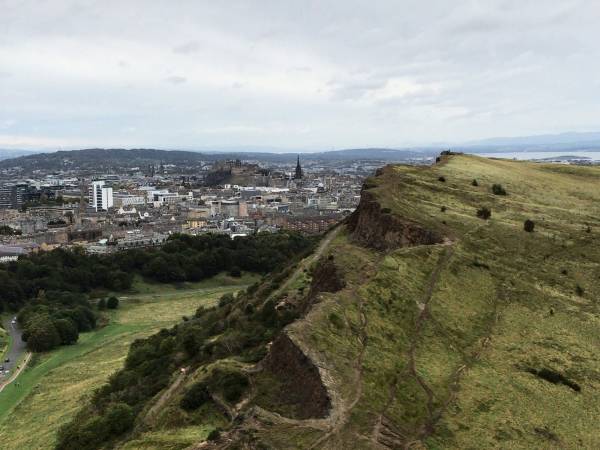
Rising before you is a miniature highland landscape in the middle of a capital city: Holyrood Park, crowned by Arthur's Seat, 251 metres above sea level. Like Castle Rock, it's the remains of a volcano extinct for hundreds of millions of years, sculpted by Ice Age glaciers into its distinctive lion-like profile. Along its western flank run the dramatic Salisbury Crags — clearly visible from where you're standing — where pioneering geologist James Hutton studied the rock formations in the 18th century and helped prove the Earth was vastly older than anyone imagined, effectively founding modern geology on that very hillside. Now, a word of honesty: the climb to the summit is a proper hill walk, not a stroll — 40 to 60 minutes each way on steep, uneven and sometimes slippery paths, so you'll want sturdy shoes, water and a spare hour or two. If your legs are up for it, a special reward awaits at the top — this guide will meet you there. If not, no matter: enjoy the view of the crags from right here, and simply carry on with the tour towards the Grassmarket. Edinburgh looks after walkers of every pace. Either way, a word about the walk ahead. Our next stop, the Grassmarket, is around two kilometres from this gate — twenty-five to thirty minutes on foot, and gently uphill most of the way. We'll take the low road: Holyrood Road, straight on into the Cowgate, which runs beneath the Old Town you walked earlier today. There's a stop along the way, about eighteen minutes from here, so you won't be walking in silence. Set off whenever you're ready.

Congratulations — you've made it! Welcome to the summit of Arthur's Seat, 251 metres above the city, and the finest free viewpoint in Edinburgh. Take a slow turn: to the north, the blue Firth of Forth stretches towards the Kingdom of Fife; to the west, the castle rides its rock above the Old Town rooftops you walked earlier today; to the south rise the Pentland Hills. Nobody is quite sure how the hill got its name — romantic tradition links it to the legendary King Arthur, though it may simply come from old Gaelic words for "height of arrows." The summit holds a genuine mystery too: in 1836, five boys hunting rabbits on these slopes found seventeen miniature coffins hidden in a small cave, each containing a tiny carved wooden figure. Were they charms, memorials — perhaps even for the victims of the body-snatchers Burke and Hare? Nearly two centuries later, nobody knows; you can see the surviving coffins in the National Museum of Scotland, which you'll pass later on this very tour. Catch your breath, take your photos — you've earned them — and when you're ready, head back down the way you came and rejoin the route towards the Grassmarket. From the park gate that's about half an hour on foot, and we'll meet you once more along the way, down in the Cowgate.

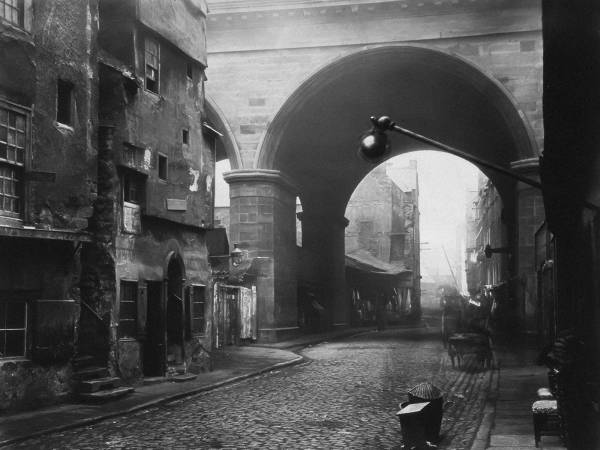
You're on the low road now — the Cowgate, a deep canyon of a street running directly beneath the Old Town you walked along the top of earlier today. Look up. Those great stone arches carrying traffic over your head are George IV Bridge and South Bridge. And remember the bridge of nineteen arches back at the Tron Kirk, the one you couldn't see? This is the arch that stayed in daylight — you're standing underneath it. The name is as plain as it sounds. From the 1330s this was the way cattle were driven down to market, and it still leads west to the place they were sold: the Grassmarket, our next stop. In 1581 a Flemish atlas described the Cowgate as the street where the noble families and city councillors had their residences. Two centuries later it was one of the poorest quarters in Britain, home to so many families who had fled the Irish famine that Victorians called it Little Ireland. Two survivors are worth a glance as you pass. The Magdalen Chapel, built in the 1540s with money left by a merchant for an almshouse for seven poor men, holds the only intact pre-Reformation stained-glass window left in Scotland. And here at the foot of Niddry Street stands St Cecilia's Hall — opened in 1763 as Scotland's first purpose-built concert hall, now a free museum of harpsichords and early keyboard instruments, open Tuesday to Saturday, with seats and a quiet room if your legs are asking for ten minutes. Otherwise keep going west: the Grassmarket, and the coffee, are about eight minutes away.

Tucked beneath the southern cliffs of the castle, the Grassmarket is one of Edinburgh's liveliest squares — and one of its most notorious. For 400 years this was the city's cattle and horse market, and from 1661 to 1784 it was also the site of public executions. The pub called The Last Drop marks the spot with dark humour. The most famous survivor was Maggie Dickson, hanged here in 1724 for concealing a pregnancy — she woke up in her coffin on the way to burial, and since the law considered her sentence carried out, she lived on for decades as "Half-Hangit Maggie." A pub still bears her name. The Grassmarket was also a haunt of Burke and Hare, the 1820s murderers who sold their victims' bodies to the anatomy schools. Today the square is far more welcoming: historic pubs, boutiques and café terraces, with one of the best views up to the castle ramparts. When you've taken the square in, walk east to the end of it. There a curving, colourful street climbs away on your left — that's our next stop, and it's worth every metre of the hill.

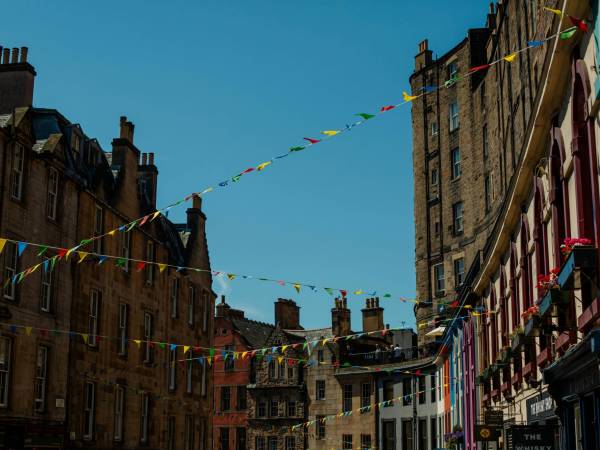
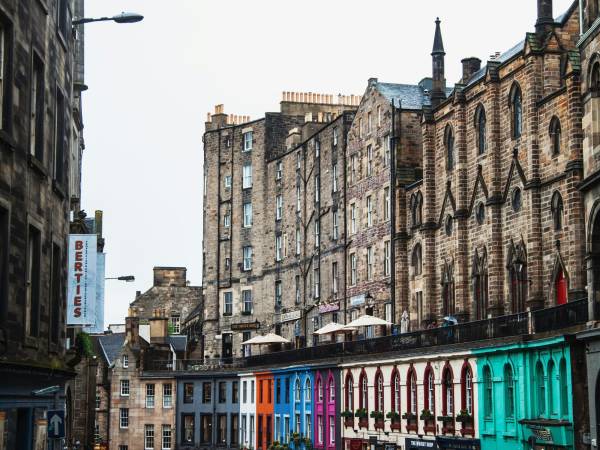
Curving up from the Grassmarket is what many call the most beautiful street in Edinburgh: Victoria Street, a graceful arc of colourfully painted shopfronts stacked beneath a second-level terrace. It was built in the 1830s as part of a scheme to improve access to the Old Town, replacing the medieval West Bow — a steep zigzag once home to the sinister Major Thomas Weir, a respected preacher executed in 1670 after confessing to a secret life of witchcraft and crime. Today the street is known for independent shops selling everything from whisky and cheese to vintage clothing and curiosities. Its rainbow of painted facades has made it one of the most photographed spots in Scotland, and many fans believe it helped inspire Diagon Alley in the Harry Potter books — J.K. Rowling famously wrote much of the early series in cafés around this neighbourhood. Take your time here; the second-storey terrace offers a lovely angle for photos. Follow the street up to the top, where it meets George IV Bridge. Turn right and head south; three or four minutes on, a small bronze dog stands on the corner, and he has a story.

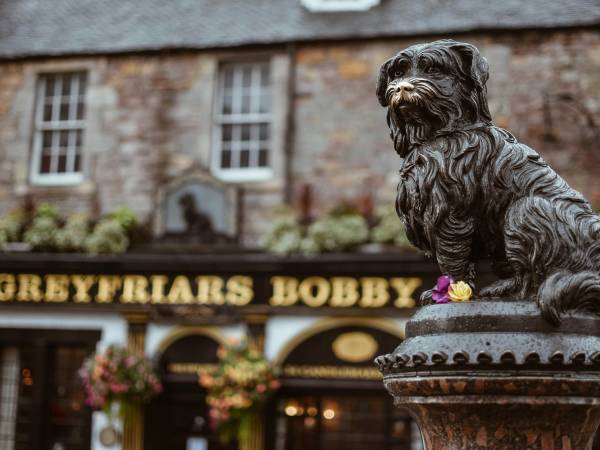
Meet Edinburgh's most beloved local: Greyfriars Bobby, the little Skye terrier whose bronze statue stands at the corner ahead. The story goes that after his master, John Gray, died in 1858, Bobby kept watch over his grave in Greyfriars Kirkyard for fourteen years, fed and cared for by locals until his own death in 1872. Visitors rub his nose for luck — so many that it has to be regularly restored. The kirkyard behind him is among the most atmospheric in Europe. Greyfriars witnessed the signing of the National Covenant in 1638, and later held over a thousand Covenanter prisoners in appalling conditions in what's now called the Covenanters' Prison. Ghost hunters know it for the "Mackenzie Poltergeist," linked to the tomb of persecutor Sir George Mackenzie. Harry Potter fans, meanwhile, hunt for gravestones bearing familiar names — including one Thomas Riddell. History, legend and literature all share this ground. Our next stop is almost on the same corner: Chambers Street runs east from here, and the long sandstone frontage a minute away is where we're heading.

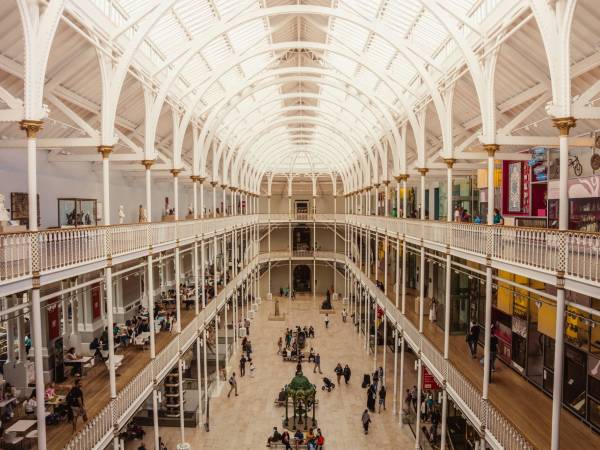
The grand building before you holds the story of Scotland — and much of the world besides. The National Museum of Scotland combines a stunning Victorian glass-roofed Grand Gallery, opened in 1866, with a modern sandstone wing devoted to Scottish history from geological deep time to the present day. The collections are wonderfully eclectic: the Lewis Chessmen, walrus-ivory chess pieces carved in the 12th century; the Monymusk Reliquary, a tiny casket associated with St Columba; Bonnie Prince Charlie's travelling canteen; and Dolly the sheep, the first mammal cloned from an adult cell, created at the nearby Roslin Institute in 1996 — now preserved and on display. There's also a rooftop terrace with a fine view over the Old Town skyline, which many visitors miss. Best of all, like Scotland's other national museums, entry is completely free. Even half an hour inside repays the visit. From here we head north. Follow George IV Bridge, cross the Royal Mile you walked earlier today, and carry on down Bank Street and The Mound until you come out at Princes Street. Allow ten minutes, and most of it is downhill.

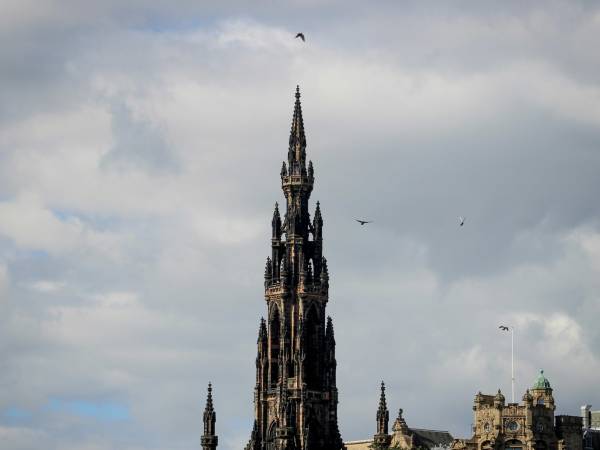
You're now crossing into the New Town, and the green valley beside you tells a remarkable story. Princes Street Gardens occupy what was once the Nor Loch — an artificial lake, and for centuries the fetid dumping ground of the Old Town, into which all manner of waste flowed downhill. It was drained around the turn of the 19th century as the elegant Georgian New Town rose to the north, and transformed into these beloved public gardens. Towering over them is the Scott Monument, completed in 1846 in memory of the novelist Sir Walter Scott — at just over 61 metres, it's said to be the largest monument to a writer anywhere in the world, a Gothic rocket of dark sandstone. Climb its 287 spiral steps for a superb view, if you don't mind a tight squeeze. Beside the gardens you'll also find the Ross Fountain and, in season, the world's oldest floral clock, planted anew each year since 1903. Before we carry on, there's something on offer. Fifteen minutes east of here, where Princes Street runs out, a small hill rises over the city — Calton Hill, and the view from the top is the one on every postcard Edinburgh has ever sold. It's an easy climb, a few minutes of steps rather than a hill walk, and this guide will meet you up there. If you'd rather stay on the flat, that's no loss at all: turn your back on the monument, head north into St Andrew Square, and we'll pick you up in the New Town.

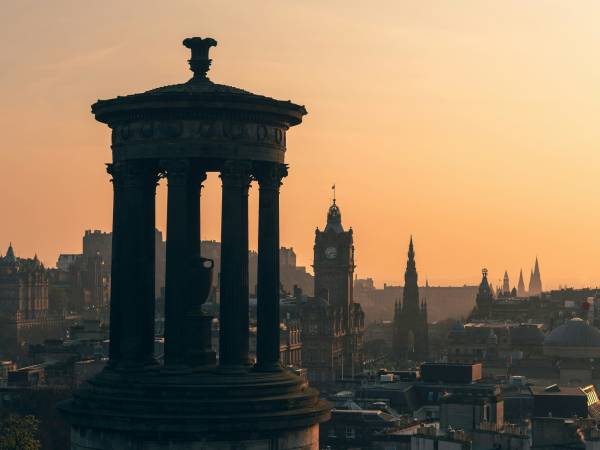
A short, easy climb brings you to Calton Hill — the view that launched a thousand postcards. From up here, the whole city arranges itself before you: the castle on its rock, the spine of the Royal Mile, Arthur's Seat brooding to the south, and the blue Firth of Forth to the north. The hill's curious collection of monuments earned Edinburgh its nickname, "the Athens of the North." The most famous is the National Monument, begun in 1826 as a replica of the Parthenon honouring Scotland's dead of the Napoleonic Wars — but funds ran out with only twelve columns built, and it was mockingly dubbed "Edinburgh's Disgrace." Time has been kind; today its unfinished columns are the city's most romantic ruin. Nearby stand the telescope-shaped Nelson Monument — whose time ball still drops at one o'clock in coordination with the castle gun — and the City Observatory. Come at sunset if you can; it's the finest show in town. When you've had your fill of it, come back down and walk west along Princes Street to St Andrew Square — about fifteen minutes — and we'll carry on into the New Town.

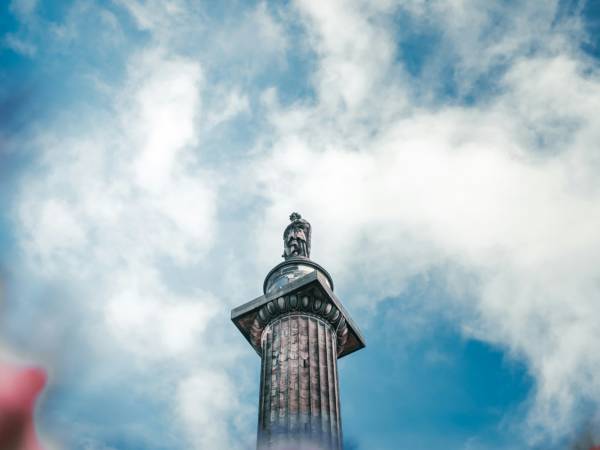
You've crossed Princes Street into a different Edinburgh altogether. Behind you, the Old Town grew where it liked — upwards, inwards, on top of itself — for six hundred years. This did not. Three straight streets running between two garden squares, drawn in one go, on paper, in 1766, by a twenty-six-year-old architect nobody had heard of called James Craig. He won the competition, the city built his plan, and what you're standing in is the largest surviving Georgian townscape in the world. George Street is the spine and this is its eastern square. Craig meant a church to stand here. He was overruled: Sir Lawrence Dundas already owned the ground and in 1774 put his own mansion on it instead, squarely on the plot meant for God. It has been the head office of the Royal Bank of Scotland since 1825, and if the doors are open, look in at the banking hall — a deep blue dome pierced by five tiers of gold-rimmed stars. The column in the gardens is the Melville Monument: forty-five metres of Trajan's Column raised in the 1820s to Henry Dundas, the man who effectively ran Scotland for a generation. It went up with a balance crane borrowed from the Bell Rock Lighthouse, designed by the engineer Robert Stevenson — grandfather of the novelist we met on the Royal Mile earlier today. A plaque added in 2021 records the harder half of the story: Dundas's part in delaying the abolition of the Atlantic slave trade. The city is still arguing about him, and the argument belongs here as much as the column does. George Street runs due west from here, and our last stop sits at the far end — about twelve minutes in a straight line. Glance down the side streets as you go: those glimpses of water to the north are no accident, they were drawn in.

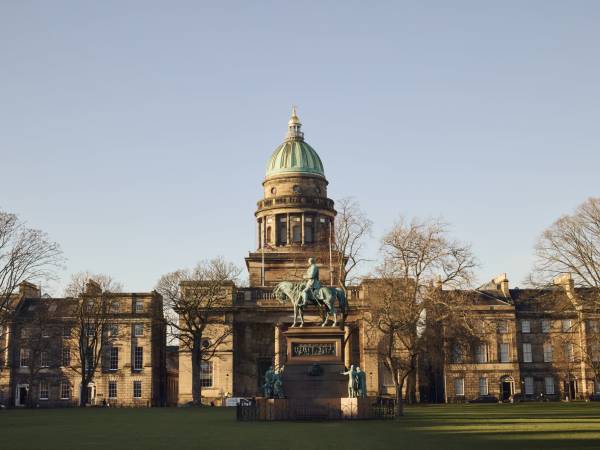
George Street ends here, and this is the New Town at its very best. Robert Adam — the most celebrated architect Britain produced in the eighteenth century — drew Charlotte Square in 1791 and died the following year, just as the first stones went down. He never saw it finished. Stand back and look at the north side: it isn't a terrace of houses at all, but a single palace front, columns and pediment and all, with separate homes hidden behind one face. That trick is why people come. Two of those doors are worth knowing. Number 6 is Bute House, the official residence of Scotland's First Minister — the black door behind every political announcement you've seen on the news. Next to it, number 7 is the Georgian House, restored by the National Trust for Scotland to how it looked in the 1790s, down to the kitchen and the wine cellar. The domed building filling the west side opened as St George's Church in 1814 and now holds national records. And the square was almost called St George's Square, until the city renamed it in 1786 after Queen Charlotte to stop it being confused with the other George Square across town. That's our tour. Look up the hill to your left: the castle esplanade where we started earlier today is about ten minutes' walk from this corner. You've been down the spine of the Old Town and underneath it, out to a palace and a volcano, through the graveyards and the museums, and back into the eighteenth century by the front door. Haste ye back — come back soon!