The Queen's House & National Maritime Museum
0
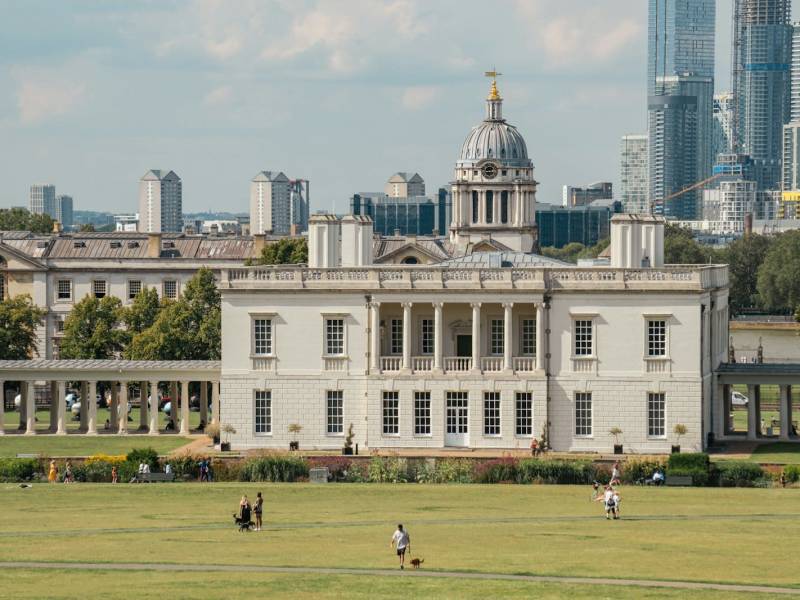
The white house at the centre is the Queen's House, and when it was finished in 1635 there was nothing else like it in England. The architect Inigo Jones had come home from Italy full of Roman and Renaissance ideas, and this was the first fully classical building in the country: pale, symmetrical and calm, at a time when English houses were red brick and crowded with gables. It was begun in 1616 for Anne of Denmark, the Danish-Norwegian princess who had married James, then King of Scotland, in Oslo in 1589. The story goes that the house was an apology. During a hunt Anne accidentally shot the king's favourite dog, and he swore at her in front of everyone. The house was built straddling the main road from London to Dover, as a private bridge between the palace by the river and the royal park. Inside is the Tulip Stairs, the first geometric self-supporting spiral staircase in Britain. In 1966 a retired Canadian clergyman photographed the stairs, which he said were empty. When the film was developed, a shrouded figure seemed to be climbing them. Nobody has explained the picture since. The wings on either side belong to the National Maritime Museum, opened in 1937. Among its two million objects is the coat Nelson was wearing when he was shot at Trafalgar, with the bullet hole still in the shoulder. Entry is free.